
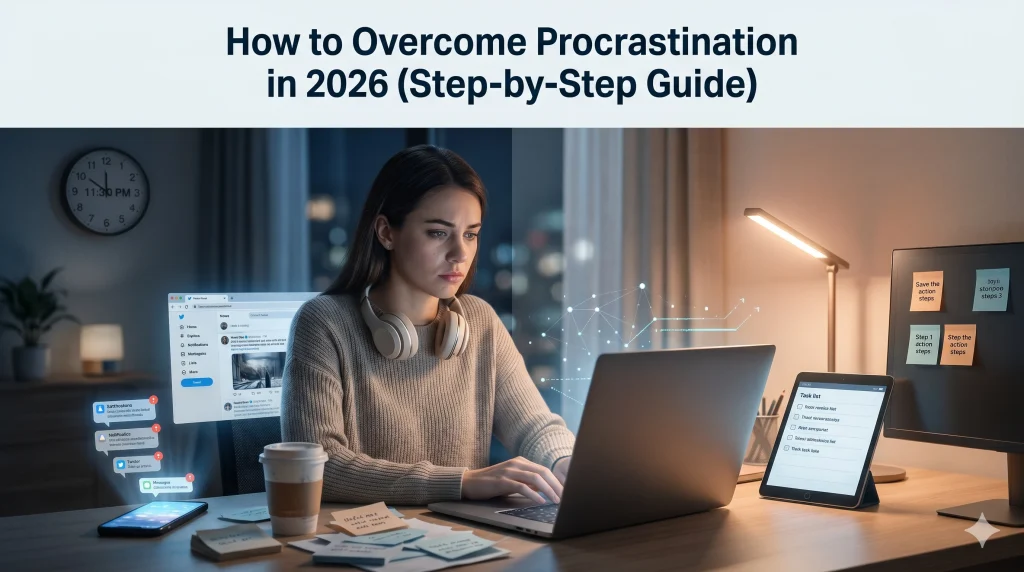
You open your laptop. The task is right there. You know exactly what needs to be done. And yet — somehow — thirty minutes later, you’ve watched three unrelated videos, reorganized your desktop icons, and made a second cup of tea you didn’t need.
Quick Summary
- Procrastination is emotional avoidance, not laziness.
- The brain prioritizes short-term comfort over long-term reward.
- Most productivity advice fails because it ignores psychology.
- Small, structured systems beat willpower every single time.
- The 2-Minute Rule, energy scheduling, and accountability loops are highly effective tools.
- Persistent procrastination may sometimes be linked to stress, anxiety, or burnout — and that’s worth paying attention to.
Table of Contents
- Why People Procrastinate
- The Psychology Behind Procrastination
- Why Most Productivity Advice Fails
- Signs You’re Stuck in a Procrastination Loop
- Types of Procrastinators
- Step-by-Step System to Overcome Procrastination
- The 2-Minute Rule
- Energy-Based Scheduling
- Reward Systems That Actually Work
- Accountability Systems
- Real-Life Examples
- Common Mistakes to Avoid
- Frequently Asked Questions
- Conclusion
- Your Action Plan Starts Now
Why People Procrastinate
Let’s clear something up right away: procrastination is not a character flaw. It’s not proof that you’re undisciplined or that you don’t care. It’s a deeply human response to discomfort.
At its core, procrastination happens when your brain decides that avoiding a task feels better — right now — than doing it. The task might feel too big, too unclear, too boring, or too emotionally loaded. So your brain, ever the short-term thinker, pulls you toward something easier and more immediately rewarding.
Research in behavioral psychology suggests that people don’t actually delay tasks because they’re managing time poorly. They delay because they’re trying to manage feelings — anxiety about failure, uncertainty about where to start, or simple overwhelm.
“Procrastination is not a time management problem. It’s an emotion regulation problem. People avoid tasks because those tasks trigger negative feelings — not because they don’t care about getting things done.”
This reframe changes everything. Once you understand that procrastination is emotional avoidance, you stop trying to force yourself through willpower alone — and start building systems that lower the emotional barrier to beginning.
The Psychology Behind Procrastination
The Present Bias
Your brain has a built-in bias toward the present. It’s called temporal discounting — the tendency to value an immediate, small reward over a delayed, larger one. This is why checking social media (instant dopamine) beats writing a report (reward comes later, after effort).
It’s not irrational. It’s wired in. Our ancestors survived by prioritizing present threats and immediate resources. Your brain hasn’t fully caught up with the reality of deadlines, career goals, or inbox zero.
The Amygdala Hijack
When you perceive a task as threatening — even mildly threatening, like “what if I do this wrong?” — the brain’s emotional center activates a low-level stress response. This makes the task feel bigger and more dangerous than it actually is. Your rational brain knows it’s just a report. Your emotional brain is treating it like a lion.
Perfectionism as a Disguise
Perfectionism and procrastination are deeply intertwined. Many people delay starting not because they don’t want to work, but because they’re afraid of producing something imperfect. Not starting feels safer than starting badly.
This is especially common among high-achieving students and ambitious professionals — the very people who often assume they “shouldn’t” struggle with procrastination.
“Done is better than perfect. But the perfectionist’s brain doesn’t believe that — and no motivational poster is going to change that belief overnight.”
Decision Fatigue
When you have too many open tasks — all vaguely important, none clearly prioritized — your brain defaults to avoidance. It’s cognitively exhausting to decide what to work on first when everything seems urgent. This kind of decision paralysis is one of the leading hidden causes of procrastination in 2026’s always-on, multi-tab work culture.
Why Most Productivity Advice Fails
You’ve probably already read the advice. “Just do it.” “Eat the frog.” “Use a to-do list.” “Set SMART goals.” And yet — here you are, still procrastinating.
Most productivity advice fails because it treats the symptom, not the cause. It focuses on what to do without addressing why you’re not doing it.
Here’s what goes wrong with common approaches:
- “Just start” — Helpful in theory, but if starting felt easy, you’d already be doing it.
- Rigid schedules — Ignoring your natural energy rhythms makes everything harder than it needs to be.
- Motivation-first thinking — Waiting to “feel motivated” is a trap. Motivation follows action, not the other way around.
- Overplanning — Writing detailed plans all day can itself be a form of procrastination disguised as productivity.
- Willpower dependency — Willpower is finite and unreliable. Systems that reduce the need for willpower consistently outperform those that demand it.
“If your strategy for overcoming procrastination relies entirely on feeling motivated, the strategy was never going to work.”
Effective systems don’t fight your brain. They work with it.
Signs You’re Stuck in a Procrastination Loop
Before building a solution, it helps to recognize the pattern. Here are honest, relatable signs that procrastination has become a loop rather than an occasional delay:
- You constantly rearrange your to-do list but never actually start the top item.
- You feel busiest in the evenings — right when the work deadline is approaching.
- You open a task, feel a vague sense of dread, and immediately switch tabs.
- You tell yourself you “work better under pressure” as a way to justify delay.
- You’ve rewritten the first paragraph of the same document five times.
- Weekends feel productive but weekdays don’t — even though that’s backwards.
- You feel guilty during rest because you should be working, and distracted during work because you’d rather rest.
Types of Procrastinators
Not all procrastination looks the same. Understanding your type helps you choose the right strategies.
| Type | Core Pattern | Common Trigger | Best Strategy |
|---|---|---|---|
| The Perfectionist | Delays because the work is never “ready” to start | Fear of failure or judgment | Set a “good enough” benchmark before starting |
| The Overwhelmed | Freezes due to too many tasks or unclear priorities | Cognitive overload | One-task-at-a-time focus; task chunking |
| The Thrill Seeker | Waits until the last minute deliberately for the adrenaline rush | Boredom with low-urgency tasks | Artificial deadlines and accountability partners |
| The Avoider | Delays tasks linked to uncomfortable emotions | Anxiety, self-doubt, past failure | Emotional decoupling; 2-minute entry technique |
| The Dreamer | Plans extensively but rarely executes | Attachment to ideas over action | Implementation intentions; reduced planning time |
| The Deplete | Delays everything due to exhaustion or low energy | Burnout, poor sleep, overcommitment | Energy management before task management |
Step-by-Step System to Overcome Procrastination
This framework isn’t a magic fix. It’s a practical system you build gradually, one layer at a time. The goal is to make starting easier and continuing more natural — until execution becomes the default, not the exception.
Step 1 — Identify the Real Blocker
Before doing anything else, ask yourself honestly: Why am I not doing this? Be specific. Is it boring? Is it unclear? Are you afraid of doing it wrong? Is it emotionally connected to something stressful?
Naming the real blocker is the first act of taking control. Vague resistance is powerful. Named resistance is manageable.
Step 2 — Shrink the Task to Its Smallest Form
Procrastination thrives on large, undefined tasks. “Write the report” is overwhelming. “Write the opening sentence of the report” is not. Break every task into its smallest actionable unit, and commit only to that unit.
This isn’t about tricking yourself. It’s about removing the startup cost — the emotional price your brain charges just to begin.
Step 3 — Set an Implementation Intention
Research in behavioral psychology consistently shows that vague intentions (“I’ll work on it later”) are far less effective than implementation intentions — specific if-then plans: “When I sit down at 10 AM, I will open the document and write for 20 minutes before checking anything else.”
Specificity removes the decision cost. Your brain doesn’t have to negotiate with itself if the plan is already made.
Step 4 — Design Your Environment
Your environment shapes your behavior more than motivation does. A cluttered desk, open browser tabs, and phone notifications are not neutral — they actively work against focused execution.
- Close unnecessary tabs before starting deep work.
- Put your phone in another room, or use a focus app.
- Keep your workspace associated with work — not Netflix, not snacking.
- If you work from home, signal to your brain that work mode is starting (a consistent pre-work ritual helps enormously).
Step 5 — Use Time Blocks, Not Open-Ended Sessions
Open-ended work sessions are exhausting and invite distraction. Bounded sessions are psychologically safer. Try working in focused 25–50 minute blocks with deliberate breaks. Knowing the session will end makes starting much easier.
The 2-Minute Rule: Your Best Entry Point
The 2-Minute Rule is straightforward: if a task takes two minutes or less, do it immediately. Don’t schedule it. Don’t add it to a list. Just do it now.
But there’s a deeper application of this rule that matters more for persistent procrastination. Ask: “Can I start this task for just two minutes?” Not complete it — just start it. Open the document. Write one sentence. Send one email. Make one decision.
“The hardest part of almost any task is the first two minutes. After that, momentum takes over. The brain is far more afraid of beginning than of continuing.”
This works because of a well-documented psychological principle: once you start a task, your brain registers it as incomplete — and unfinished tasks generate a low-level mental pull to complete them. Psychologists call this the Zeigarnik effect. Starting is the activation key.
Energy-Based Scheduling: Work With Your Biology
Most scheduling advice ignores something fundamental: not all hours are equal. Your cognitive performance, focus capacity, and emotional resilience all fluctuate throughout the day based on your chronobiology — your internal body clock.
Trying to do your most demanding creative or analytical work when your energy is low is like trying to run uphill in sand. You can do it, but it’s far harder than it needs to be.
How to Identify Your Peak Hours
Spend one week tracking your energy levels at different points in the day — morning, mid-morning, early afternoon, late afternoon, and evening. Rate your focus and mental clarity on a simple 1–5 scale. Patterns will emerge quickly.
Matching Tasks to Energy Levels
- High energy (your peak hours): Deep work, creative tasks, complex problem-solving, important decisions.
- Medium energy: Meetings, collaborative work, emails, editing.
- Low energy: Administrative tasks, routine data entry, light research, organizing files.
Many people do the opposite — answering emails and doing admin when they’re fresh, then trying to write or think deeply when they’re mentally depleted. This is one of the most common and least-recognized contributors to end-of-day procrastination.
Reward Systems That Actually Work
The brain is a reward-seeking organ. Procrastination often wins because the reward for completing a task is delayed, vague, or abstract — while the reward for distraction is immediate and concrete.
The solution isn’t to lecture yourself about discipline. It’s to make the process of working more immediately rewarding.
Practical Reward Strategies
- Temptation bundling: Pair a task you avoid with something you enjoy. Only listen to your favorite podcast while doing a specific tedious task. Only have your preferred coffee during morning deep work.
- Progress tracking: Visually marking progress — a checklist, a streak counter, a simple tally — gives small dopamine rewards throughout the process, not just at completion.
- Milestone rewards: Set a genuine reward for completing a significant block of work — not “I’ll feel good about myself,” but something tangible and pleasurable that you actually look forward to.
- Completion rituals: End each focused work session with a small consistent ritual — a brief walk, a specific snack, closing all tabs deliberately. Rituals signal closure and reinforce the cycle.
“You don’t need to make work feel like play. You just need to make it feel slightly more rewarding than avoidance.”
Accountability Systems: The Underrated Multiplier
Accountability is one of the most consistently effective tools against procrastination — and one of the least used by people who work independently. When only you know whether you did the work, it’s surprisingly easy to rationalize delay.
Types of Accountability That Work
- Accountability partner: A friend, colleague, or peer you check in with regularly — sharing your intentions and reporting back. Even a weekly five-minute check-in changes behavior significantly.
- Body doubling: Working in the presence of another person — even silently, even on video call — reduces the ease of distraction for many people. Virtual co-working sessions have become genuinely popular for this reason.
- Public commitment: Telling someone (or a group) that you will complete a specific task by a specific time creates external social stakes that complement internal motivation.
- Written commitments: Writing down your intention — on paper, in a journal, in a specific document — increases follow-through more than mental intention alone.
Accountability doesn’t mean surveillance or pressure. It means creating a gentle external structure that supports your own intentions.
Real-Life Examples
The Student Before an Assignment
Priya, a postgraduate student in Delhi, found herself opening her research document every morning — and closing it twenty minutes later having done nothing. She wasn’t lazy; she was terrified of writing something inadequate. Her solution: she committed to writing exactly 150 words every morning before checking her phone. No quality expectations. Just 150 words. Within three weeks, she had a complete draft — and the quality was far better than she’d expected, because momentum had taken over.
The Entrepreneur with Too Many Ideas
Rahul ran a small digital agency. He consistently deferred client reports in favor of brainstorming new business ideas — which felt exciting, while reporting felt tedious. Once he recognized this as the “Dreamer” pattern, he scheduled all new-idea brainstorming for Friday afternoons only. Execution work — reports, client communication, deliverables — got his peak morning hours. Within a month, his deliverable quality improved, client satisfaction increased, and ironically, his creative ideas became more grounded because they were no longer a form of avoidance.
The Remote Worker in a Distraction-Rich Home
Working from home in 2026 brings a unique procrastination challenge: the environment is built for comfort, not focus. Arjun, a content manager working remotely, started using a simple pre-work ritual: a five-minute walk outside, followed by sitting at a specific desk (not the sofa), with a specific playlist, before opening his task manager. The ritual itself cued his brain into “work mode.” Within two weeks, starting work felt noticeably less effortful.
Common Mistakes When Trying to Beat Procrastination
- Waiting for motivation before starting. Motivation is a byproduct of action, not a prerequisite for it. Start first, feel motivated second.
- Building a perfect system instead of using an imperfect one. Elaborate productivity setups are themselves a form of procrastination. A simple system you actually use beats a perfect system you only plan to use.
- Using self-criticism as a motivator. Guilt and shame about past procrastination tend to increase avoidance, not reduce it. Self-compassion paired with accountability is far more effective.
- Trying to change everything at once. Picking one habit to build at a time is significantly more effective than attempting a complete behavioral overhaul.
- Ignoring physical factors. Poor sleep, low physical activity, and inadequate nutrition directly impair focus and willpower. These aren’t soft lifestyle tips — they’re functional prerequisites for sustained attention.
- Confusing busy-ness with productivity. Checking emails, attending unnecessary meetings, and organizing tasks can all be sophisticated forms of procrastination that feel virtuous.
Quick Wins Checklist
If you want to start reducing procrastination today — without overhauling your entire system — start here:
- ☑ Pick the one task you’ve been avoiding the longest. Do just two minutes of it right now.
- ☑ Close every browser tab not related to your current task.
- ☑ Put your phone in another room for the next 30 minutes.
- ☑ Write down your single most important task for tomorrow — before you go to sleep tonight.
- ☑ Tell one person what you’re going to accomplish this week.
- ☑ Identify your highest-energy hour of the day and protect it for deep work.
- ☑ Remove one recurring distraction from your work environment permanently.
Frequently Asked Questions
Why do people procrastinate?
People procrastinate primarily because tasks trigger negative emotions — anxiety, boredom, self-doubt, or overwhelm — and the brain seeks relief from those feelings by shifting attention to something more immediately comfortable. Procrastination is fundamentally an emotion regulation response, not a reflection of laziness or poor time management.
Is procrastination linked to anxiety?
There is a well-recognized relationship between procrastination and anxiety. Tasks that feel uncertain, high-stakes, or emotionally loaded can activate mild anxiety responses that make avoidance feel temporarily relieving. However, this article is not a clinical resource — if you believe anxiety is significantly affecting your daily functioning, a qualified mental health professional is the appropriate person to speak with.
How do I stop procrastinating immediately?
The fastest way to interrupt procrastination is to commit to starting for just two minutes. Don’t commit to finishing — just starting. Open the document. Write one line. Make one decision. In most cases, the activation barrier — not the task itself — is what’s making it feel impossible. Starting dissolves that barrier almost immediately.
What is the 2-Minute Rule?
The 2-Minute Rule has two practical applications. First: if a task takes two minutes or less to complete, do it now rather than adding it to a list. Second: for larger tasks you’re avoiding, commit to working on the task for just two minutes as a starting mechanism. The goal of the second application is activation — getting started — not completion.
Why do smart, ambitious people procrastinate?
High-achieving people often procrastinate precisely because of high standards. Perfectionism — the fear of producing imperfect work — is more common among people who care deeply about quality. Smart people are also better at rationalizing delay with plausible-sounding justifications. Ambition without structured execution systems often produces sophisticated procrastination.
Can procrastination become a habitual pattern?
Yes. Like most behaviors, procrastination reinforces itself over time. Each time avoidance provides relief from a stressful task, the brain learns that avoidance is an effective coping strategy. Over time, this becomes a default response to perceived difficulty. This is why breaking the pattern requires more than willpower — it requires consistently replacing the avoidance response with a starting response until the new pattern becomes more automatic.
How long does it take to overcome procrastination?
There’s no universal timeline, and it’s important to be honest about that. Small behavioral changes — like the 2-Minute Rule or environment design — can produce noticeable results within days or weeks. Deeper patterns, especially those connected to perfectionism or anxiety, take longer to shift and may benefit from consistent effort over months. Progress is rarely linear. Expect some backsliding, and treat it as data rather than failure.
Conclusion: Progress Over Perfection, Action Over Intention
If there’s one thing this guide has tried to make clear, it’s this: procrastination is not a moral failure. It’s a pattern — a learned, understandable, deeply human pattern — that can be interrupted, redirected, and gradually replaced with something better.
You don’t need to become a different person. You don’t need an extreme productivity transformation. You need a slightly better system, applied consistently, with enough self-awareness to understand why you get stuck and enough self-compassion to not let the guilt compound the delay.
“The goal isn’t to never procrastinate again. The goal is to make starting easier than avoiding — one task, one day, one honest two minutes at a time.”
The psychology behind procrastination is real. The emotional barriers are real. But so is your capacity to build systems that work around them. Energy-based scheduling, the 2-Minute Rule, accountability partners, environment design, reward systems — none of these require extraordinary willpower. They require intention, honesty about your patterns, and a willingness to start before you feel completely ready.
In 2026, the world isn’t getting simpler or quieter. Distractions aren’t disappearing. The gap between people who execute consistently and those who stay stuck in loops of delay will likely grow wider, not narrower. But you already know what to do.
The question is always the same. Not “do you have enough motivation?” but: what are the next two minutes for?
Your Action Plan Starts Now
Don’t let this article become something you read, nodded at, and then forgot. That would be a very ironic form of procrastination.
Here’s your immediate action plan:
- Right now: Identify the one task you’ve been avoiding most. Write it down explicitly.
- In the next 5 minutes: Do just two minutes of that task. Just start it. Nothing more.
- Today: Identify your peak energy hour and block it for deep work tomorrow morning.
- This week: Tell one person one specific thing you’re going to complete. Check in with them at the end of the week.
- This month: Pick one strategy from this guide — just one — and practice it consistently for 30 days before adding another.
“You don’t have to be ready. You just have to begin.”
Start with one task. Start with two minutes. Start right now.




More Stories
100 Non-Negotiable Rules for Men
Salvaging Wardrobes: The Definitive Guide to Removing Set-In Grease Stains After Washing
Restoring Clarity: How to Clean Oven Glass With Baking Soda Without Harsh Chemical Sprays