
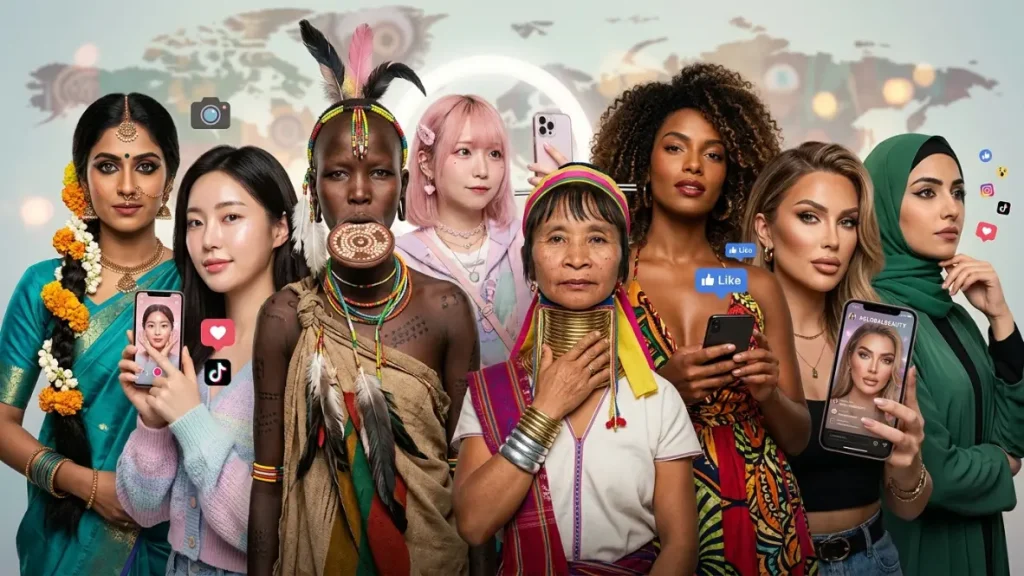
Have you ever stopped to wonder why beauty standards around the world are so wildly different from one country to the next? What is considered gorgeous in one culture might be completely unremarkable — or even undesirable — in another. That’s the fascinating, sometimes puzzling, and deeply human reality of beauty.
What Are Beauty Standards Around the World?
Beauty standards are the unspoken (and sometimes very loudly spoken) rules that a society sets about what is attractive. They cover everything — body shape, skin tone, hair texture, facial features, posture, and even the way someone carries themselves.
These standards are not born in a vacuum. They grow out of history, religion, colonialism, economics, media, and local culture. And here’s something important to remember: beauty is not universal. There is no single global rulebook.
What’s considered beautiful in Seoul might be the opposite of what’s admired in Lagos. That’s not a flaw in human thinking — it’s actually a testament to how rich and varied our cultures are. Understanding cultural beauty standards helps us see the world through a wider lens and challenge the narrow definitions we’ve been handed.
“Beauty is in the eye of the beholder — and the beholder is shaped by culture, history, and circumstance.”
— Social Anthropology Perspective
Strange and Weird Beauty Standards in Different Countries
Let’s travel the world and look at some of the most surprising — and sometimes shocking — beauty trends in different countries that are still very much alive today.
South Korea
South Korea has become one of the world’s most influential beauty markets, and with that influence come some very specific ideals. A small face, double eyelids, a V-shaped jawline, and porcelain skin are considered the ultimate markers of attractiveness.
The country has one of the highest rates of cosmetic surgery per capita globally. Procedures like double eyelid surgery (blepharoplasty) and jaw reduction are remarkably common — even gifted to teenagers as graduation presents. It’s a beauty culture that is simultaneously breathtaking in its innovation and sobering in its pressure.
The global phenomenon of K-beauty has also pushed multi-step skincare routines and glass-skin aesthetics into millions of bathrooms worldwide.
India
In India, fair skin has been historically prized — a standard deeply rooted in colonial history and a complex caste system. The skin-lightening cream industry in India is worth billions of dollars, which speaks volumes about how deeply this ideal is embedded in daily life.
Yet India is also a land of contradictions. Celebrated actresses like Deepika Padukone and Priyanka Chopra have darker complexions and have challenged these norms on international stages. Meanwhile, long black hair, kohled eyes, and a full figure have historically been idealized in traditional art and literature.
The beauty conversation in India is evolving — slowly, but unmistakably.
Japan
Japan’s cultural beauty standards have long celebrated a kind of gentle, understated elegance. Pale skin, small lips, and a slender frame remain popular ideals, but Japan also has a unique concept called “kawaii” (cute culture) that prizes childlike features and wide, innocent-looking eyes.
Interestingly, Japan also has a historical appreciation for slightly crooked teeth — called “yaeba” — which were once seen as endearing and youthful. Some women even paid to have their teeth made less straight. Yes, you read that right. That’s one of the more surprising entries in our list of weird beauty standards.
Brazil
Brazil is famous worldwide for its celebration of the body. Curvaceous figures, tanned skin, and a prominent backside are considered highly attractive, reflected in fashion, carnival culture, and media representation.
Brazil also has one of the highest rates of cosmetic surgery in the world — not just for elite classes, but across income levels. Beauty here is not a luxury; it’s often seen as a civic duty. The cultural importance of looking good is woven into everyday social interactions.
African Tribes
Across the African continent, beauty standards are as diverse as the cultures themselves. Some of the most striking examples include:
- Kayan women of Myanmar (also practiced by some groups in East Africa) — neck elongation using brass rings, considered a mark of elegance and wealth.
- Mursi and Suri tribes of Ethiopia — women wear large clay lip plates, seen as a symbol of beauty and social status.
- Dinka people of South Sudan — tall, lean body types and facial scarification are viewed as marks of beauty and identity.
- Wodaabe tribe of Niger — in a fascinating gender reversal, men compete in beauty pageants to attract women, with long necks, white teeth, and wide eyes being prized male features.
These traditions remind us that beauty rituals are always about much more than looks — they’re about belonging, identity, and heritage.
“In the Wodaabe tribe, men are the ones who paint their faces and dance to be chosen. Beauty, here, is a man’s art.”
— National Geographic, Cultural Documentation
Western Countries
In the West — particularly in the United States, UK, and much of Europe — modern beauty ideals have shifted dramatically over the decades. From the hourglass figures of the 1950s to the heroin chic of the 1990s to today’s emphasis on athleisure fitness and “natural” aesthetics, beauty trends have been anything but stable.
Today, social media filters, influencer culture, and the rise of the “Instagram face” — a look characterized by high cheekbones, full lips, a button nose, and flawless skin — have created a new kind of beauty homogeneity. Paradoxically, in trying to celebrate diversity, social media sometimes flattens it.
The Psychology of Beauty
Why do we care so much about beauty? The psychology of beauty offers some fascinating answers.
Research in evolutionary psychology suggests that some preferences — like clear skin, symmetrical faces, and signs of health — may be hardwired because they signal reproductive fitness. But that’s only part of the story. Culture shapes attraction far more than biology alone.
The “halo effect” is a well-documented psychological phenomenon where attractive people are automatically assumed to be smarter, kinder, and more competent. This bias has real-world consequences in hiring, relationships, and social mobility.
There’s also the concept of “beauty privilege” — the measurable advantages that conventionally attractive people receive in society. Studies from economics, law, and medicine have all found that attractive individuals earn more, receive lighter sentences, and are treated more favorably in healthcare.
Understanding these dynamics is not about making people feel bad about caring for their appearance. It’s about being honest about the systems that shape our perceptions.
“We don’t see beauty objectively. We see it through the lens of everything we’ve been taught to value.”
— Psychology of Aesthetics, Creativity, and the Arts
Pros and Cons of Global Beauty Standards
Like most cultural forces, global beauty standards come with both benefits and drawbacks. Here’s an honest look at both sides.
| ✅ Pros | ❌ Cons |
|---|---|
| Encourage personal grooming and self-care habits | Create unrealistic and unattainable ideals |
| Drive innovation in skincare, fashion, and wellness industries | Promote discrimination based on skin tone, body size, or features |
| Help people feel part of a shared cultural identity | Erase cultural diversity by promoting a single “ideal” look |
| Can motivate people to lead healthier lifestyles | Linked to eating disorders, anxiety, and low self-esteem |
| Modern standards increasingly include diverse body types and skin tones | Heavily commercialized — often driven by profit, not empowerment |
| Social media enables grassroots challenges to old norms | Social media filters distort beauty perception in harmful ways |
Traditional vs Modern Beauty Ideals: A Comparison
Beauty standards are not static — they evolve with each generation. Here’s how real beauty vs trend beauty has shifted over time across different cultures.
| Aspect | Traditional Beauty Ideals | Modern Beauty Ideals |
|---|---|---|
| Body Shape | Fuller figures (symbol of wealth and fertility) | Slim but toned; “hourglass” or “athletic” builds |
| Skin Tone | Pale skin (upper class in Asia, Europe); dark skin (sun vitality in some cultures) | Mixed: “sun-kissed” in the West; still fair-skin ideal in parts of Asia |
| Hair | Long, natural, unstyled hair as feminine ideal | Diverse: natural, colored, short, textured all celebrated |
| Makeup | Minimal in many cultures; kohl and turmeric in South Asia | Wide range: from no-makeup look to full glam and artistic expression |
| Age | Maturity and experience often respected as beautiful | Youth heavily prioritized; anti-aging industry booming |
| Cultural Influence | Shaped by local tradition, oral history, and religion | Shaped by social media, global celebrities, and K-beauty/Western media |
Are Beauty Standards Harmful?
This is one of the most important questions we need to ask when talking about cultural beauty standards. The honest answer? It depends — but the potential for harm is very real.
When beauty standards are tied to painful physical modification — like foot binding (historically in China), extreme corseting, or dangerous skin-bleaching chemicals — the harm is direct and physical. When they’re tied to mental ideals that are impossible to achieve, the harm becomes psychological.
Research consistently shows that exposure to unrealistic beauty imagery increases body dissatisfaction. This is true for women, men, and non-binary individuals alike. No one is immune to the pressure of being told they don’t quite measure up.
There’s also the issue of colorism — discrimination based on skin tone within communities of the same ethnicity. In South Asia, East Asia, Latin America, and among Black communities, lighter skin is often treated as more desirable. This isn’t just a beauty issue; it’s a social justice issue with real economic consequences.
How to Build a Healthy Beauty Perception
The good news? Beauty perception is not fixed. It can be consciously cultivated and expanded. Here are some genuinely helpful steps:
- Diversify your feed. Follow people of different ethnicities, ages, body types, and abilities on social media. What you see regularly shapes what you consider normal and beautiful.
- Audit your media consumption. Be mindful of how much time you spend on platforms that make you feel bad about your appearance. Unfollow accounts that consistently trigger comparison.
- Learn cultural context. Understanding why a beauty standard exists — its history and social meaning — makes it easier to evaluate it critically rather than accept it blindly.
- Talk to yourself kindly. The language you use about your own body matters. Replace harsh self-criticism with curiosity and compassion.
- Remember: confidence is also beauty. This isn’t a cliché — it’s backed by research. People who carry themselves with ease and self-assurance are consistently rated as more attractive, regardless of conventional physical features.
- Celebrate function over form. Appreciate what your body does — not just how it looks. Strength, endurance, health, and the ability to experience joy are all forms of beauty.
Building a healthier relationship with beauty isn’t about abandoning care for your appearance — it’s about refusing to let any single cultural standard be the final word on your worth.
Frequently Asked Questions
1. What are beauty standards around the world?
Beauty standards around the world are the culturally defined norms about what is considered attractive in a specific society. They vary greatly across countries and are influenced by history, media, religion, and economics.
2. Why do beauty standards differ across cultures?
Because culture shapes attraction. Local history, geography, colonial influence, and media all play a role. What’s admired in Japan may be completely different from what’s valued in Brazil or Nigeria — and that’s perfectly natural.
3. How does social media affect beauty standards?
Social media beauty standards are heavily influenced by filtered images, influencer culture, and viral beauty trends. While social media has amplified diversity in some ways, it has also created new pressures around appearance, especially for younger users.
4. Are weird beauty standards harmful?
Some weird beauty standards can be physically or psychologically harmful — particularly those involving painful body modification or the reinforcement of colorism and racial discrimination. Awareness and critical thinking are essential tools for navigating these issues.
5. How can I develop a healthy beauty perception?
Start by diversifying what you consume visually, practicing self-compassion, and reminding yourself that confidence is also beauty. Understanding that real beauty vs trend beauty is not the same thing is a powerful first step toward a healthier self-image.
Conclusion
Beauty standards around the world are one of the most revealing mirrors of human culture. They show us what societies value, fear, celebrate, and sometimes wish to control. From the clay lip plates of Ethiopia to the double-eyelid surgery clinics of Seoul, from the skin-lightening creams of Mumbai to the social media filters of Los Angeles — every standard has a story, and every story deserves to be understood with empathy and curiosity.
The most important thing to carry away from all of this is simple: beauty is not universal. It never was, and it probably never will be. And that’s actually something to celebrate.
In a world increasingly homogenized by global media, honoring the diversity of cultural beauty standards is a quiet act of resistance. Whether you’re drawn to K-beauty routines, Ayurvedic rituals, West African adornment traditions, or your grandmother’s natural skincare wisdom — all of it belongs in the conversation about what it means to look and feel beautiful.
So the next time you scroll past an image that makes you feel like you don’t measure up, remember: you are not behind on a trend. You are living in a body shaped by your own unique history, culture, and story. Confidence is also beauty — and no filter required.
“This blog stands out because it doesn’t just discuss beauty standards — it explains the cultural psychology behind them in a highly engaging and globally relatable way.”



How Social Media Changed Beauty Standards
If there is one force that has reshaped global beauty standards in the last decade more than anything else, it is social media.
Platforms like Instagram, TikTok, and YouTube have given ordinary people the power to become beauty influencers — and with that power has come an unprecedented speed of trend cycles. A beauty look can go from niche to mainstream in a matter of days.
But the dark side is real. Social media filters allow users to smooth skin, enlarge eyes, slim noses, and reshape jawlines with a single tap. When people spend hours consuming these filtered images — including filtered versions of themselves — it distorts their beauty perception.
Studies link heavy social media use to increased rates of body dysmorphia, anxiety, and eating disorders, particularly among teenagers. The concept of “Snapchat dysmorphia” — where people seek plastic surgery to look like their filtered selfies — is now a recognized clinical phenomenon.
Yet social media has also been a force for good. The body positivity movement, representation of diverse skin tones, disabilities, and body types, and the rise of “de-influencing” content have all pushed back against narrow beauty ideals.