
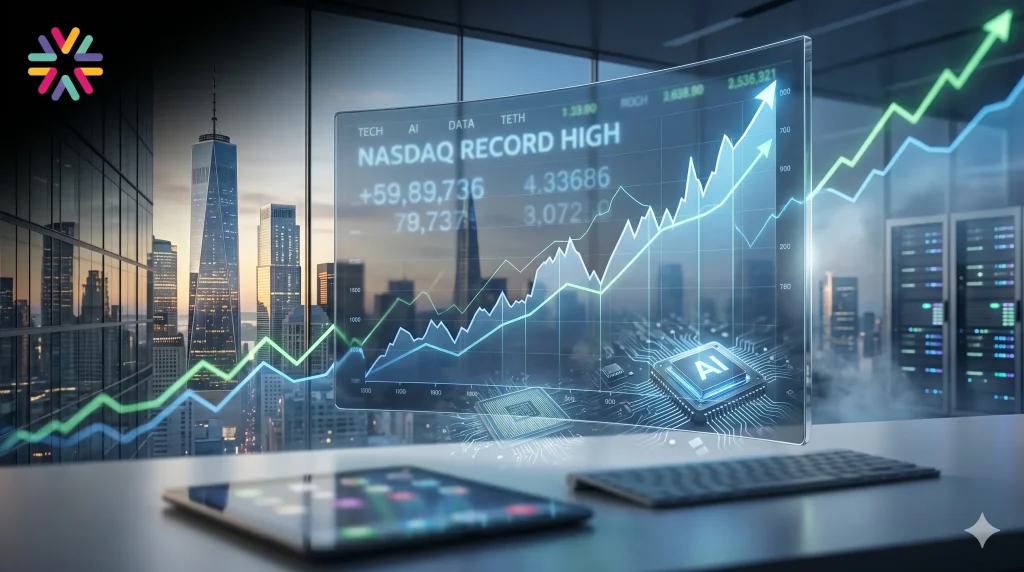
The rally is not just about one company or one earnings report. It reflects a bigger belief that AI spending, chip demand, cloud infrastructure, and data-center growth are becoming the strongest engines of the U.S. stock market in 2026.
Why Tech Stocks Rising Today
- Tech stocks are rising today because investors are betting that artificial intelligence demand will keep driving revenue growth across chips, cloud computing, software, and data centers.
- The Nasdaq record high May 12 story is tied to strong momentum in AI-related companies and renewed confidence in large-cap technology stocks.
- AI chip stocks surge 2026 has become a major market theme as demand grows for advanced processors, memory chips, networking gear, and AI servers.
- Nvidia stock price news today remains central because Nvidia is still viewed as a major leader in AI computing infrastructure.
- The S&P 500 tech rally shows that technology is not only lifting the Nasdaq, but also supporting the broader U.S. stock market.
What Is Happening in the Stock Market?
Technology stocks are rising because investors are again treating artificial intelligence as the most powerful growth story in the market. The Nasdaq has climbed to a record high, and the rally is being led by companies connected to AI infrastructure, semiconductor manufacturing, cloud platforms, enterprise software, and data-center equipment.
In simple terms, investors believe companies are still spending heavily to build the next generation of AI systems. That spending benefits more than just one famous chipmaker. It reaches memory-chip companies, networking firms, server makers, cloud providers, power equipment suppliers, and software platforms that help businesses use AI at scale.
This is why the latest Nasdaq record high May 12 discussion has become such a major news topic. The move suggests that investors are no longer treating AI as a short-lived hype cycle. They are treating it as a long-term infrastructure buildout similar to earlier technology waves, including the internet, smartphones, and cloud computing.
The strongest momentum has been in companies that can directly benefit from the physical demands of AI. Large AI models require powerful chips, fast memory, advanced networking, huge data centers, and reliable energy systems. As more businesses adopt AI tools, the demand for this infrastructure continues to grow.
That is the heart of the rally. Investors are not simply buying “tech” in a broad way. They are buying companies that appear positioned to capture spending from the AI economy.
Why AI Demand Is Driving the 2026 Tech Rally
The main reason tech stocks are rising today is that AI demand has moved from excitement to real spending. Companies are not only testing AI chatbots or experimental tools. They are building AI into customer service, software development, advertising, cybersecurity, healthcare research, finance, logistics, and workplace automation.
That shift requires serious computing power. Every AI search, image request, business automation tool, or enterprise assistant needs infrastructure behind it. The more AI becomes part of daily business operations, the more demand grows for chips, servers, storage, cloud capacity, and networking equipment.
This explains why AI chip stocks surge 2026 has become one of the most important market themes. The rally is no longer limited to graphics processors. Investors are also watching memory chips, custom silicon, optical networking, cooling systems, and server companies.
Nvidia remains the symbol of the AI boom because its processors are widely used for training and running advanced AI models. That is why Nvidia stock price news today matters to both professional investors and everyday market watchers. When Nvidia rises, it often boosts confidence across the entire AI trade.
But the 2026 rally is broader than Nvidia alone. Memory companies are gaining attention because AI workloads need fast and high-capacity memory. Networking companies are rising because data centers need to move huge amounts of information quickly. Server makers are benefiting because businesses need physical systems to run AI applications.
This broader participation makes the current rally more durable than a single-stock move, but it also creates new risks if expectations become too high.
Why the Nasdaq Record High May 12 Matters
The Nasdaq record high May 12 headline matters because the Nasdaq is heavily weighted toward technology and growth companies. When the Nasdaq reaches a record, it signals that investors are willing to pay higher prices for future earnings growth.
That confidence is important after years of concern about inflation, interest rates, global conflict, and stretched valuations. A record high does not mean the market is risk-free. It means buyers are currently more focused on growth potential than on fear.
For the U.S. economy, the rally shows that technology remains the most influential sector in public markets. Many retirement accounts, index funds, and 401(k) portfolios are tied to the performance of large technology stocks. When tech rises, millions of American investors may see gains in their portfolios, even if they do not own individual chip stocks directly.
For businesses, the rally sends another message: AI investment is becoming a competitive necessity. Companies that delay AI adoption may worry about falling behind competitors. Companies that supply AI infrastructure may see stronger demand, better pricing power, and greater investor attention.
For consumers, the impact is more indirect. A strong tech market can support hiring, innovation, and new products. But it can also increase concerns about market concentration, automation, and whether stock prices are rising faster than real-world profits.
What Is Driving the Tech Rally?
| Market Driver | Why It Helps Tech Stocks | Key Opportunity | Main Risk |
|---|---|---|---|
| AI chip demand | Companies need advanced processors to train and run AI systems | Higher revenue for chip leaders and suppliers | Valuations may rise too far too fast |
| Data-center expansion | AI tools require large-scale computing facilities | Growth for servers, networking, storage, and power systems | Energy costs and infrastructure limits could slow growth |
| Cloud AI adoption | Businesses use cloud platforms to access AI tools without owning hardware | Recurring revenue for cloud and software companies | Competition may pressure margins |
| Strong tech earnings | Investors gain confidence when companies show real AI-related growth | Better market sentiment and higher stock prices | Any earnings miss could trigger sharp pullbacks |
| Investor rotation into growth | Money moves back into high-growth sectors when confidence improves | Broad support for the Nasdaq and S&P 500 tech rally | Rate changes or inflation surprises can reverse momentum |
Why It Matters Right Now for U.S. Readers
The S&P 500 tech rally matters because technology now has an unusually large influence on the broader U.S. stock market. Even investors who never buy individual tech names may still own them through index funds, target-date funds, mutual funds, or retirement accounts.
When large technology companies rise, the effect can lift the entire market. That can improve household wealth, support investor confidence, and make headlines feel more positive. But the opposite is also true. If the same large companies fall, they can pull down major indexes quickly.
This creates a practical lesson for everyday investors: diversification matters. A strong market does not always mean every sector is doing well. In 2026, AI-related companies are carrying much of the excitement, while other areas of the market may move more slowly.
For workers, the rally has another meaning. AI is not just a Wall Street story. It is changing job roles, productivity expectations, and the tools companies use. Businesses are investing in AI because they believe it can save time, reduce costs, improve customer service, and create new products.
For consumers, AI demand may lead to better apps, faster services, smarter devices, and more personalized digital experiences. But it may also raise concerns about privacy, job displacement, and the power of a small group of major technology companies.
Risks, Concerns, and Opposing Views
The bullish case is clear: AI demand is real, spending is large, and the technology sector is generating strong investor interest. But the opposing view deserves attention.
The biggest concern is valuation. Many AI-linked stocks have already risen sharply. When expectations become extremely high, even good results may not be enough. A company can grow quickly and still see its stock fall if investors expected even more.
Another concern is concentration. If a small number of companies drive most of the market’s gains, the market can become fragile. A disappointing earnings report, supply-chain issue, regulatory action, or slowdown in AI spending could affect more than one stock.
There is also the question of profitability. AI infrastructure is expensive. Building data centers, buying chips, hiring engineers, and powering large systems require massive investment. Some companies may spend heavily before they prove that AI can produce strong returns.
Investors should also watch interest rates. High-growth stocks are sensitive to borrowing costs because their value depends heavily on future earnings. If inflation rises or rate-cut hopes fade, technology valuations could face pressure.
Finally, there is the bubble debate. Some analysts believe AI will transform the economy. Others worry that parts of the rally look overheated. The truth may be mixed: AI can be a real revolution while some stock prices still become too expensive in the short term.
What Readers Should Do Now
For beginners, the best response to a tech rally is not panic buying. It is careful planning.
First, understand what you own. If you have an S&P 500 fund or a Nasdaq fund, you may already have significant exposure to technology stocks. You may not need to buy more individual AI names to participate in the trend.
Second, avoid chasing headlines. A stock rising today does not guarantee it will keep rising tomorrow. Strong companies can still experience sharp pullbacks, especially after major rallies.
Third, focus on business quality. Look for companies with real revenue growth, strong balance sheets, durable demand, and clear competitive advantages. In AI, the strongest businesses are often those selling essential infrastructure or software that customers cannot easily replace.
Fourth, think in time horizons. Short-term traders may care about daily price movements. Long-term investors should care more about earnings growth, market position, and whether the company can keep compounding value over several years.
Fifth, manage risk. No trend lasts in a straight line. A balanced portfolio can help investors benefit from technology growth without becoming fully dependent on one sector.
Future Outlook: What Happens Next?
The future of the tech rally depends on whether AI demand continues to turn into real earnings. Investors will watch upcoming earnings reports, data-center spending plans, chip supply, cloud growth, and corporate AI adoption.
If companies keep showing strong AI-related revenue, the rally may continue. The next phase could include more gains in memory, networking, cloud software, cybersecurity, and energy infrastructure connected to AI data centers.
If demand slows, or if companies signal that spending is becoming too expensive, the market could cool quickly. The stocks that rose the most may also fall the fastest if expectations reset.
Regulation could also shape the outlook. U.S. policymakers are paying closer attention to AI safety, chip exports, data privacy, competition, and energy usage. New rules could create winners and losers across the sector.
Still, the long-term direction appears clear. AI is becoming part of how businesses operate. The question is not whether AI matters. The question is which companies can turn AI demand into sustainable profit.
Why Are Tech Stocks Rising Today?
Why are tech stocks rising today?
Tech stocks are rising today because investors are betting on continued artificial intelligence demand, strong semiconductor growth, cloud spending, and data-center expansion. The rally is strongest in companies connected to AI infrastructure.
Why did the Nasdaq hit a record high in May 2026?
The Nasdaq hit a record high because technology and AI-related stocks gained momentum. Investors are optimistic that AI spending will continue supporting revenue growth for chipmakers, cloud companies, software firms, and data-center suppliers.
Are AI chip stocks still a good investment in 2026?
AI chip stocks may still offer long-term opportunity, but many have already risen sharply. Investors should study earnings, valuation, competition, and risk before buying based only on recent price momentum.
Why is Nvidia stock price news today important?
Nvidia stock price news today matters because Nvidia remains one of the most important companies in AI computing. Its performance often influences sentiment across the semiconductor sector and the broader Nasdaq.
Can the S&P 500 tech rally continue?
The S&P 500 tech rally can continue if earnings grow, AI demand stays strong, and interest-rate conditions remain supportive. However, high valuations and concentrated market leadership create risks for investors.
Conclusion
The latest rise in technology stocks is not just a daily market move. It reflects a deeper belief that artificial intelligence is becoming the central growth engine of the U.S. economy and the stock market.
For RankAshva, the 2026 tech rally is not simply a story of rising stock prices; it is a story of capital following conviction, as investors decide that AI infrastructure may define the next decade of American market leadership.
The key takeaway is simple. Tech stocks are rising because AI demand is real, powerful, and still expanding across multiple industries. But investors should stay balanced. The best opportunities often come from understanding the trend clearly, not from chasing the loudest headline.
As the Nasdaq reaches new highs and the S&P 500 tech rally continues, the smartest readers will watch both sides of the story: the growth potential of AI and the risks that come with paying too much for future promise.




More Stories
Why the U.S. Government Ordered Restrictions on Anthropic’s Claude Fable 5 and Mythos 5
PURSUE UFO Files: The Truth Behind the May 2026 Declassified Videos
Inside the Oval Office: How Silicon Valley Leaders Stopped the 2026 AI Executive Order