
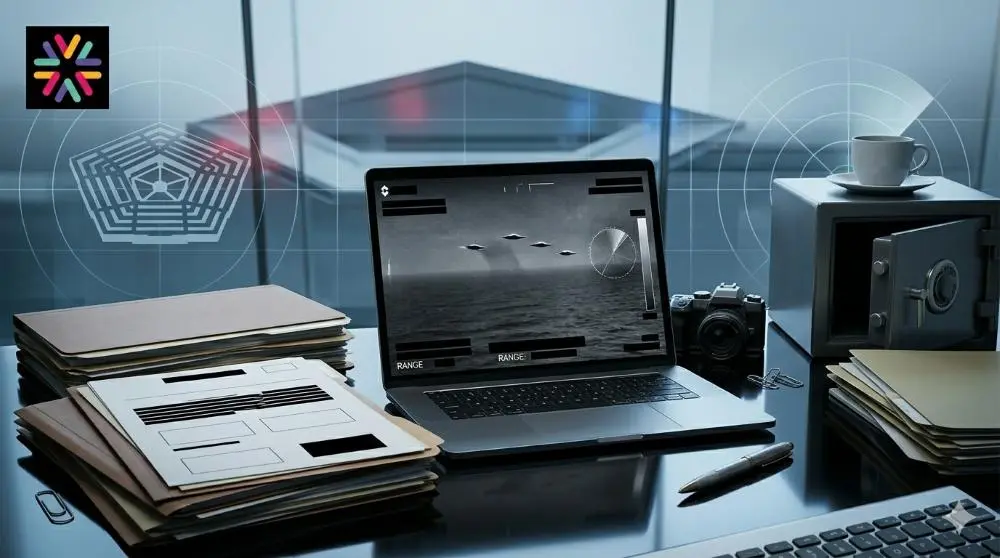
The new PURSUE UFO files have turned a long-running American mystery into one of the biggest transparency stories of 2026.
For decades, UFO and UAP records lived in scattered archives, military reports, old agency files, and public speculation. Now, the May 2026 releases have placed declassified videos, documents, images, and witness accounts into a single public-facing pipeline. The result is not a simple answer about aliens. It is a much more serious conversation about national security, public trust, data quality, and how Americans should understand the unknown.
Quick Answer: What Are the PURSUE UFO Files?
- The PURSUE UFO files are newly released U.S. government records related to unidentified anomalous phenomena, commonly called UAPs or UFOs.
- The first major May 2026 release arrived on May 8, followed by a second release on May 22.
- The material includes declassified videos, documents, images, historical records, and witness accounts from multiple government agencies.
- The government describes many of these cases as unresolved, meaning officials do not yet have enough evidence to make a final determination.
- The release does not prove alien life, but it does show that UAP reporting has become a mainstream issue involving defense, aviation safety, science, and public transparency.
What Is Happening With the PURSUE UFO Files?
The May 2026 PURSUE documents mark a major public release of UAP-related records through a dedicated government portal. PURSUE stands for the Presidential Unsealing and Reporting System for UAP Encounters. The goal is to identify, review, declassify, and release government records connected to unidentified anomalous phenomena.
The first release went live on May 8, 2026. A second release followed on May 22, 2026. Together, these releases created a new public archive for people who want to examine the original materials rather than rely only on rumors, edited clips, or social media commentary.
The records cover a wide range of material. Some are modern infrared videos connected to military sensors. Others are older historical reports, agency documents, astronaut audio references, and first-hand narratives. The most important point is that the files are not being presented as final answers. They are being released as records that remain unresolved or historically significant.
That distinction matters. In everyday language, “unidentified” can sound dramatic. In technical terms, it often means something much narrower: the available data is not strong enough to confirm what the object or event was. A blurry object on an infrared sensor, a fast-moving light, or a strange shape near water may remain unexplained because the camera angle, metadata, sensor information, distance, weather, or supporting radar data is incomplete.
Why the Pentagon UAP Videos Release Is Trending
The Pentagon UAP videos release is trending because it combines three powerful public interests: government secrecy, unexplained objects, and national security. UFO stories have always attracted attention, but this release feels different because it is tied to official records, not just anonymous claims or viral clips.
Americans are also more sensitive to airspace security after years of drone concerns, surveillance fears, balloon incidents, and debates about advanced foreign technology. A strange object in the sky is no longer treated only as a science-fiction curiosity. It may raise real questions about military readiness, aviation safety, sensor blind spots, and the limits of current detection systems.
The timing also explains the attention. The May 2026 releases arrived in a highly connected media environment where short videos can spread within minutes. A single infrared clip can become a national conversation before experts have time to explain what the footage can and cannot show.
That creates a challenge for readers. The same video can mean very different things depending on context. A glowing object may be a balloon, drone, bird formation, aircraft, satellite reflection, sensor artifact, or something not yet identified. Without full telemetry, sensor details, altitude, speed, environmental data, and chain-of-custody, even serious analysts may disagree.
Why the US UFO Files 2026 Matter Right Now
The US UFO files 2026 release matters because it shifts the discussion from belief to evidence. For years, the UFO debate was often framed as a fight between believers and skeptics. The PURSUE documents move the conversation toward a more useful question: what does the data actually support?
For the public, the release offers a rare look at how the government stores and shares UAP material. For journalists and researchers, it creates a source base that can be compared, sorted, and challenged. For defense officials, it highlights the difficulty of identifying unusual events across air, sea, space, and military operating zones.
The release is also relevant to businesses and consumers. The skies are more crowded than ever. Commercial drones, private aerospace projects, satellite constellations, weather balloons, experimental aircraft, and advanced sensors all increase the chance that ordinary people will see something they cannot immediately identify. More sightings do not automatically mean more extraordinary objects. They may also mean more cameras, more aircraft, more sensors, and more public awareness.
For social media users, the lesson is even simpler: a government-released video is not the same thing as a government-confirmed explanation. The file may be authentic, but the interpretation may still be open.
Comparison Table: What the PURSUE Documents Show vs. What They Do Not Prove
| Area | What the PURSUE Files Show | What They Do Not Prove | Reader Takeaway |
|---|---|---|---|
| Declassified videos | Some clips show objects, lights, or heat signatures that were not immediately identified. | They do not automatically prove alien technology or advanced foreign systems. | Watch the footage as evidence, not as a final conclusion. |
| Historical records | Older files show that UAP reports have existed across decades and agencies. | They do not mean every past sighting was extraordinary. | Historical context helps explain why the topic keeps returning. |
| Military sensor data | Some records involve infrared imagery, military platforms, or restricted operating areas. | They do not always include enough metadata to identify speed, distance, size, or origin. | Missing data is often the reason a case remains unresolved. |
| Public transparency | The government is releasing materials in tranches and inviting outside review. | Transparency does not guarantee that every file will answer every question. | The value is in access, comparison, and continued analysis. |
| Scientific meaning | The files may support better research into unusual observations and reporting patterns. | They do not replace controlled scientific study or high-quality multi-sensor evidence. | The strongest conclusions will require better data collection. |
Risks, Concerns, and Opposing Views
The biggest risk is misinterpretation. A declassified video can look dramatic while still showing something ordinary. Infrared sensors are powerful, but they can also make familiar objects appear strange. Distance, zoom, heat signatures, compression, and camera movement can all change how an object appears.
Skeptics argue that many UAP cases are likely caused by common objects, including balloons, birds, aircraft, satellites, drones, or atmospheric effects. They also point out that “unresolved” does not mean “unexplainable forever.” It often means the available evidence is too limited to reach a confident answer.
Disclosure advocates take a different view. They argue that the public deserves fuller access to raw data, less redaction, and a more complete explanation of how UAP cases are reviewed. Some also worry that the most important records may remain classified because of national security concerns, sensor capabilities, or intelligence methods.
Both sides raise valid points. The public should not jump to conclusions, but it should also expect serious government accountability. If objects are appearing near military assets, sensitive airspace, or strategic locations, the issue deserves careful study even if the final explanation is not exotic.
What Readers Should Do Next
First, separate the file from the claim. A video may be real, but the caption, viral post, or online interpretation may be wrong. Always ask what the source actually says.
Second, look for context. Useful details include the date, location, sensor type, altitude, direction of travel, weather, duration, and whether radar or other sensors confirmed the event. A short clip without context is interesting, but it is rarely enough to prove a major claim.
Third, avoid treating every unresolved case as a mystery with the same importance. Some cases remain unresolved because they are genuinely unusual. Others remain unresolved because the data is incomplete, low quality, or missing supporting information.
Fourth, watch for exaggerated headlines. The phrase “UFO files” attracts clicks, but the modern government term is UAP, which is broader and more technical. It includes unidentified objects or events that may have ordinary explanations.
Finally, keep an open but disciplined mind. The best approach is neither automatic belief nor automatic dismissal. The strongest position is evidence-based curiosity.
Future Outlook: What May Happen After the May 2026 Releases
The PURSUE process is expected to continue with additional releases. That means the public conversation is likely to grow, especially if future batches include more military videos, older intelligence records, or cases involving unusual movement across air, sea, or space.
The next phase may also bring more independent analysis. Researchers, aviation experts, data scientists, former military personnel, and open-source investigators will likely examine the videos frame by frame. Some cases may become less mysterious after careful review. Others may remain difficult because the records do not include enough supporting data.
Artificial intelligence may also play a role. Pattern recognition, image enhancement, satellite tracking, and sensor comparison tools could help identify objects that once seemed impossible to classify. But AI will not be magic. If the original data is weak, the output will still be limited.
Over time, the most important change may be cultural. Pilots, service members, and civilians may feel more comfortable reporting unusual observations without stigma. Better reporting could lead to better data, and better data is the only path toward better answers.
FAQ About the PURSUE UFO Files
What are the PURSUE documents?
The PURSUE documents are declassified and historical U.S. government records related to unidentified anomalous phenomena. They include videos, images, reports, narratives, and agency materials released through a public government process.
Do the May 2026 declassified videos prove aliens exist?
No. The videos show events or objects that were not fully identified based on available evidence. An unresolved case is not the same as proof of extraterrestrial life or technology.
Why are the US UFO files 2026 important?
They matter because they make government UAP records easier for the public, researchers, and journalists to examine. They also connect the UFO debate to real issues such as airspace safety, military awareness, transparency, and data quality.
What does UAP mean?
UAP stands for unidentified anomalous phenomena. It is the modern term used by government agencies for unexplained objects or events observed in the sky, sea, space, or other domains.
Will more Pentagon UAP videos be released?
Yes, more releases are expected as the government continues reviewing and declassifying records. Future tranches may add new videos, documents, images, and historical files.
Conclusion
The May 2026 PURSUE UFO files are important not because they settle the UFO debate, but because they make the debate more serious. The public now has access to more official material, but access is only the first step. The real work is interpretation.
These files show that the U.S. government has collected UAP reports across agencies, decades, and technologies. They also show that many cases remain unresolved because the evidence is incomplete, not because the most dramatic explanation is automatically true.
“RankAshva editorial view is clear: the PURSUE files should be read not as a shortcut to belief, but as a rare public test of evidence, transparency, and national curiosity.”
The smartest takeaway is balanced: stay curious, demand better data, and resist easy conclusions. The truth behind the PURSUE documents may not be simple, but the May 2026 releases have made one thing clear. The question of what moves through American skies is no longer fringe. It is now a public, scientific, and national security conversation that deserves careful attention.




More Stories
Why the U.S. Government Ordered Restrictions on Anthropic’s Claude Fable 5 and Mythos 5
Inside the Oval Office: How Silicon Valley Leaders Stopped the 2026 AI Executive Order
What is Cockroach Janta Party? Founder, Agenda and the Story Behind Its 20M Instagram Buzz