
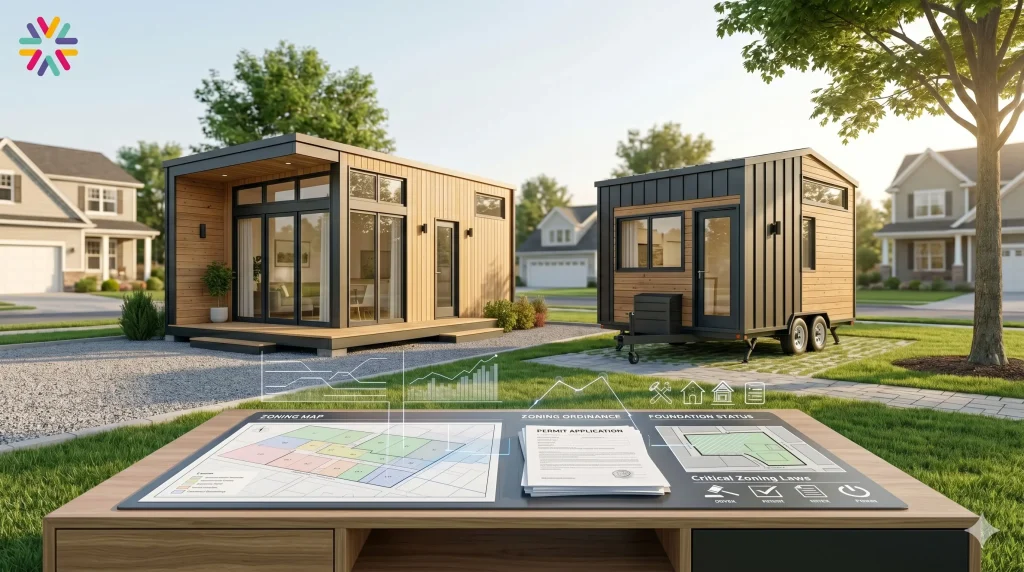
Tiny homes look simple from the outside, but the legal path to living in one is anything but small.
Across the United States, zoning reform, accessory dwelling unit rules, housing shortages, and rising construction costs are pushing tiny homes into the mainstream. But before you buy land, order a prefab unit, or build a tiny house on wheels, one question matters most: will your local government actually allow you to live in it?
Quick Answer: Tiny Home Zoning Laws 2026 Guide
- Tiny homes are not automatically legal everywhere. State rules may help, but city and county zoning usually decide what can be built or occupied.
- A tiny house on wheels is often treated differently from a tiny home on a permanent foundation. Wheels may trigger RV, campground, mobile home, or temporary-use rules.
- Appendix Q, now referenced in later code versions under updated appendix labels, helps explain tiny house building standards. It generally applies to homes 400 square feet or less, but only where adopted.
- Legal parking is usually limited to approved land uses. These may include ADU lots, tiny home communities, RV parks, manufactured home parks, or permitted rural parcels.
- The safest first step is a written zoning verification. Never rely only on a real estate listing, builder promise, or social media advice.
What Is Happening With Tiny Home Laws in 2026?
The tiny home movement has shifted from a minimalist lifestyle trend into a serious housing conversation. In 2026, more Americans are looking at tiny homes because traditional housing has become expensive, mortgage rates remain difficult for many buyers, and cities are under pressure to create more flexible housing options.
At the same time, state and local governments are rethinking old zoning rules. Accessory dwelling units, backyard cottages, garage conversions, and small secondary homes are getting more attention as practical ways to add housing without building large apartment complexes.
That does not mean every tiny house is suddenly legal. The biggest mistake beginners make is assuming that a tiny home is legal because it is small, mobile, affordable, or advertised as “code-ready.” In reality, legality depends on three separate questions: what the structure is, where it sits, and how it will be used.
A 300-square-foot cottage on a permanent foundation may be treated as a dwelling. A similar-sized unit on wheels may be treated as a recreational vehicle. A backyard tiny home may be allowed as an accessory dwelling unit in one city but rejected in another because of setbacks, utilities, fire access, or parking limits.
Why Tiny Home Zoning Laws Are Trending Right Now
Tiny homes are trending because they sit at the intersection of affordability, lifestyle, climate awareness, and local housing reform. Many people want a smaller home with lower costs. Homeowners want backyard rental income or space for family members. Cities want more housing without dramatically changing neighborhood character.
The trend is especially strong in states and metro areas where accessory dwelling unit reform is moving forward. California continues to be a major example because state law has pushed local governments to permit ADUs more consistently. New York City has also opened the door to more backyard and ancillary dwelling units under broader housing reform. Virginia has moved toward statewide ADU rules that limit how far local governments can restrict qualifying units.
For everyday readers, the lesson is clear: the opportunity is real, but the paperwork matters. Tiny homes are becoming more accepted, yet the legal process still depends on zoning districts, building codes, utility approvals, and occupancy rules.
The 7 Critical Zoning Laws You Must Check Before You Build
1. Zoning District Rules
Your land’s zoning district is the starting point. A parcel may be zoned residential, agricultural, rural residential, commercial, mixed-use, or something more specific. Each district controls what kind of dwelling is allowed.
Ask the planning office whether a tiny home is allowed as a primary residence, accessory dwelling unit, guest house, temporary structure, RV, manufactured home, or campground use. Do not ask only, “Can I put a tiny home here?” Ask, “Can I legally live in this specific structure full-time on this specific parcel?”
2. Tiny House on Wheels vs. Permanent Foundation Laws
This is one of the biggest legal dividing lines in the United States. A tiny home on a permanent foundation is usually reviewed like a residential dwelling. It may need building permits, inspections, utility connections, and compliance with local residential code.
A tiny house on wheels is more complicated. Many local governments classify it as an RV, even if it looks like a home. That can make full-time living difficult outside approved RV parks, campgrounds, or specially zoned communities. Some places allow tiny houses on wheels as ADUs or long-term dwellings, but that is still highly local.
3. Appendix Q Building Code Explained
Appendix Q is a common search term for tiny home building code rules. It was introduced to make small homes easier to build safely by addressing compact stairs, lofts, ceiling heights, ladders, guards, and emergency escape openings.
In simple terms, Appendix Q and its later code references help building officials evaluate tiny houses that are generally 400 square feet or less. However, it is not a nationwide permission slip. A state or local government must adopt the relevant appendix or equivalent rules before you can rely on them.
Also remember that Appendix Q does not usually solve zoning by itself. It may help answer, “How can this tiny home be built safely?” It does not always answer, “Where can this tiny home be placed?”
4. Minimum Square Footage for Tiny Homes by State
Many readers search for minimum square footage for tiny homes by state, but the real answer is often local. Some states have modernized building or ADU rules, while many cities and counties still control minimum home size through zoning, building codes, or subdivision standards.
Older rules may require a minimum dwelling size that makes very small homes difficult. Newer ADU laws may allow smaller units, especially if they include permanent provisions for sleeping, cooking, sanitation, and living. Because the rules can change by city, the best approach is to verify minimum floor area, room dimensions, ceiling height, and lot standards with the local building department.
5. ADU and Backyard Cottage Rules
Accessory dwelling units are one of the most promising legal pathways for tiny homes in 2026. An ADU may be detached, attached, above a garage, inside a basement, or built as a backyard cottage.
However, ADU rules can include limits on size, height, setbacks, owner occupancy, short-term rentals, parking, entrances, design, fire separation, and utility connections. In some states, local governments must approve qualifying ADUs through a more predictable process. In other areas, approval remains more discretionary.
6. Utility, Septic, Water, and Fire Access Requirements
A tiny home still needs safe living systems. Even if zoning allows the use, you may need approval for sewer, septic, potable water, electricity, stormwater, driveway access, and fire department access.
This is especially important on rural land. A parcel that looks perfect online may fail because the soil cannot support a septic system, the road is not approved for emergency vehicles, or utility extensions are too expensive. Off-grid living may be possible in some areas, but it is still regulated.
7. Parking, Setbacks, Lot Coverage, and Use Restrictions
Local zoning often controls where the structure sits on the lot. Setbacks determine how far it must be from property lines. Lot coverage rules limit how much of the parcel can be covered by buildings. Parking rules may require off-street spaces. Design standards may control height, roof pitch, materials, or visibility from the street.
Use restrictions also matter. Some communities allow tiny homes for long-term occupancy but ban short-term rentals. Others allow seasonal RV stays but not permanent residence. Homeowner associations and deed restrictions can add another layer, even when the city would allow the project.
Where Can I Legally Park a Tiny House in the US?
The safest legal options usually fall into a few categories. You may be able to place a tiny home in an approved tiny house community, on a permitted ADU lot, in an RV park that allows long-term stays, in a manufactured home park that accepts the unit type, or on rural land where zoning and utilities support full-time residential use.
Legal tiny house communities in the USA are growing, but they are not all the same. Some are lifestyle communities. Some are RV-style parks. Some are permanent cottage developments. Before signing anything, confirm whether full-time occupancy is allowed, what building standard applies, and whether the home can be financed or insured.
Comparison Table: Tiny Home Legal Pathways in 2026
| Tiny Home Option | Best Use Case | Main Opportunity | Main Risk |
|---|---|---|---|
| Permanent foundation tiny home | Full-time residence on owned land | Clearer building-code pathway | Minimum size, zoning, and utility limits |
| Tiny house on wheels | Flexible living or temporary placement | Mobility and lower upfront commitment | Often classified as an RV, limiting full-time use |
| Backyard ADU | Family housing, rental income, aging in place | Expanding legal support in many states | Permits, setbacks, utilities, and rental limits |
| Tiny home community | People who want shared amenities and clearer placement | Community infrastructure may already be approved | Lease terms, fees, and occupancy rules vary widely |
Risks, Concerns, and Opposing Views
Tiny homes are not a perfect solution. Critics argue that they can create parking pressure, strain utilities, reduce privacy, or change neighborhood character. Some planners worry that poorly regulated units may create safety problems or encourage informal housing that is difficult to inspect.
There are also financial risks. Tiny homes can be harder to finance, appraise, insure, and resell than conventional homes. A tiny house on wheels may depreciate more like a vehicle than real estate. A unit placed without proper permits may become expensive to move, retrofit, or legalize later.
The strongest opposing view is that tiny homes are helpful but not enough. They can support affordability, family flexibility, and smaller-footprint living, but they cannot solve the national housing shortage alone. They work best as part of a broader housing strategy that includes apartments, starter homes, ADUs, zoning reform, and infrastructure investment.
What Readers Should Do Before Buying or Building
Start with the land, not the house. A beautiful tiny home is useless if the parcel cannot legally support it.
First, identify the parcel number and zoning district. Then call or email the local planning department and ask for written confirmation of allowed uses. Next, contact the building department to ask which residential code applies, whether the local area recognizes Appendix Q or a later tiny-house appendix, and what inspections are required.
If the home will be on wheels, ask whether full-time occupancy is allowed and whether it will be classified as an RV, park model, manufactured home, mobile home, or another structure type. If the home will be an ADU, request the local ADU checklist and confirm size, setbacks, utility, parking, and rental rules.
Finally, verify water, sewer or septic, electricity, driveway access, fire access, flood zone status, HOA restrictions, deed restrictions, and short-term rental rules. Keep all answers in writing. A short email from the planning office can protect you from a costly misunderstanding.
How to Verify Land for Tiny Home Use
Use this beginner-friendly checklist before making a deposit:
- Find the parcel number and zoning classification.
- Confirm whether residential occupancy is allowed.
- Ask whether the tiny home can be a primary dwelling, ADU, RV, or temporary unit.
- Check minimum square footage, setbacks, height, and lot coverage.
- Confirm the building code and permit process.
- Verify septic, sewer, water, and power availability.
- Review HOA rules, deed restrictions, and local rental limits.
Future Outlook: What Happens Next?
In 2026 and beyond, expect tiny homes to become more accepted through ADU reform, pre-approved building plans, faster permit timelines, and more flexible zoning in high-cost housing markets. More cities may allow backyard cottages, garage conversions, and smaller detached units as a practical response to affordability pressure.
At the same time, tiny houses on wheels will likely remain the most legally complicated category. Unless more jurisdictions create clear rules for permanent occupancy, many wheeled tiny homes will continue to face RV-style restrictions.
The future is promising, but not automatic. The winners will be homeowners and buyers who treat tiny living like a real estate project, not just a lifestyle purchase.
FAQ: Tiny Home Permit Requirements 2026
Do I need a permit for a tiny home in 2026?
Usually, yes. A permanent tiny home typically needs building permits and inspections. A tiny house on wheels may need zoning approval, RV certification, utility approval, or placement permission depending on the location.
Can I live full-time in a tiny house on wheels?
Sometimes, but it depends on local law. Many areas treat tiny houses on wheels as RVs, which can limit full-time occupancy. Always confirm long-term residential use before buying land or moving the unit.
Is Appendix Q accepted in every state?
No. Appendix Q and later tiny-house appendix language are model code provisions. They only help if the state or local jurisdiction has adopted the relevant code language or created a similar local rule.
What is the easiest legal path for a tiny home?
For many people, the easiest path is a permitted ADU, a permanent foundation tiny home in a supportive jurisdiction, or a lot inside an approved tiny home community. The easiest option depends on the local zoning district and how the home is classified.
Can I buy rural land and put a tiny house on it?
Not automatically. Rural land may still have zoning, septic, water, driveway, fire access, flood zone, and minimum dwelling requirements. Verify everything with the county before closing.
Conclusion
The 2026 tiny home roadmap is full of opportunity, but the smartest buyers are not asking only how small they can build. They are asking whether the land, structure, utilities, and occupancy use all line up legally.
“The future of tiny living is not just smaller design; it is smarter verification. RankAshva views the 2026 tiny home movement as a practical housing shift only when lifestyle dreams are matched with zoning reality.”
Before you build, park, rent, or move in, get written answers from the local planning and building offices. Tiny homes can be affordable, elegant, and deeply practical, but only when the legal foundation is as strong as the physical one.




More Stories
The Return of Capris and Kitten Heels: How to Style 2026’s Biggest Y2K Fashion Revival
Fibermaxxing Explained: The 2026 Gut Health Trend Replacing the Protein Craze
Spring 2026 Fashion Trends: Why Crochet Shirts and Boudoir Aesthetics Are Taking Over Summer