
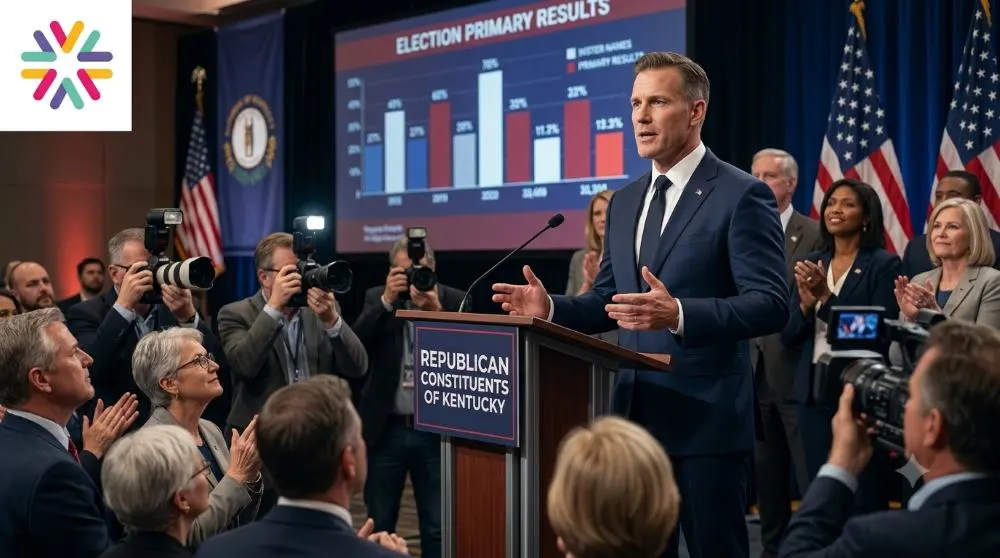
A congressional primary in northern Kentucky became one of the clearest political signals of 2026.
What looked like a district-level fight between Republican incumbent Thomas Massie and challenger Ed Gallrein turned into a national test of power, loyalty, money, and Donald Trump’s influence over the Republican Party. The result was decisive: Gallrein won, Massie lost, and the message to GOP lawmakers was hard to miss.
The Kentucky primary election results 2026 now stand as a major early marker for the midterm cycle.
Quick Answer: What Happened in the Kentucky Primary?
- Ed Gallrein defeated Rep. Thomas Massie in Kentucky’s 4th Congressional District Republican primary.
- The race became the most expensive House primary in history, with spending reports reaching more than $32 million in advertising.
- Donald Trump backed Gallrein after repeatedly criticizing Massie for breaking with him on major issues.
- Massie’s defeat shows the risk of challenging Trump inside today’s Republican Party.
- Gallrein now moves toward the general election in a strongly Republican district.
Kentucky Primary Election Results 2026: Why Gallrein’s Victory Matters
The Kentucky primary election results 2026 matter because this was not a normal House primary. Most congressional primaries are local contests about district issues, candidate experience, fundraising, and party organization. This one became something larger.
Ed Gallrein, a Trump-backed Republican challenger, defeated Thomas Massie, a seven-term incumbent known for his independent libertarian streak. Massie had built a reputation as one of the most willing Republicans in Congress to oppose party leaders, question spending bills, resist foreign intervention, and challenge Trump directly.
That independence once helped define his political brand. In 2026, it helped make him a target.
Gallrein’s campaign framed the race around loyalty, strength, and alignment with Trump’s agenda. Massie’s campaign framed it around principle, independence, and resistance to outside pressure. Republican voters in the district chose Gallrein.
The result does not simply remove one incumbent from Congress. It signals that Trump’s endorsement still carries major weight in Republican primaries, especially when combined with heavy outside spending and a clear loyalty-based message.
Who Is Ed Gallrein?
Ed Gallrein entered the race as a challenger with a profile designed to appeal to modern Republican primary voters. He was presented as a military veteran, a conservative outsider, and a candidate closely aligned with Trump.
His pitch was direct: Kentucky’s 4th District needed a representative who would support the president’s agenda instead of resisting it. That argument gave Republican voters a simple contrast.
On one side was Massie, the long-serving incumbent with a record of voting his own way. On the other side was Gallrein, the challenger promising closer alignment with Trump and the current direction of the GOP base.
In many elections, incumbency is a major advantage. Name recognition, local relationships, and years of constituent service usually matter. But in this race, incumbency became less valuable than alignment with the national Republican mood.
Why Thomas Massie Became a Target
Thomas Massie was not a moderate Republican. He was a conservative with a strong following among libertarian-leaning voters, fiscal hawks, and people skeptical of foreign aid, surveillance, and large federal spending packages.
But Massie’s problem was not that he was insufficiently conservative in a traditional sense. His problem was that he repeatedly showed he was willing to defy Trump.
That difference is important. In today’s Republican Party, ideology and loyalty are not always the same thing. A lawmaker can be very conservative and still face a serious primary threat if the party base sees him as disloyal to Trump.
Massie’s opposition to key Trump-backed positions, his criticism of federal spending, and his push for transparency on sensitive political issues made him stand out. For supporters, that made him principled. For Trump-aligned critics, it made him unreliable.
The Gallrein victory shows which interpretation won the primary electorate.
Why the Race Became So Expensive
The spending in the race turned a Kentucky House primary into a national political spectacle. Reports described it as the most expensive House primary on record, with tens of millions of dollars flowing into advertising, messaging, and outside political efforts.
That level of spending matters because it shows how high the stakes were for national Republicans, donors, advocacy groups, and Trump-aligned political forces.
For Gallrein’s supporters, the spending was a necessary effort to defeat an incumbent they believed no longer represented the direction of the party. For Massie’s supporters, it showed how outside money can overwhelm a local race and reshape voter perception through constant advertising.
Both arguments reveal something true about modern politics: congressional primaries are no longer always local. A single House race can become a proxy battle for national power.
Why This Race Was Trending Nationally
The Gallrein-Massie race trended because it brought together several major political themes at once.
First, it was a Trump loyalty test. Trump did not simply endorse a candidate in an open seat. He backed a challenger against a sitting Republican incumbent. That made the race personal and symbolic.
Second, it involved record-breaking money. A House primary that attracts more than $32 million in reported advertising is no longer just a district contest. It becomes a national story about influence and power.
Third, it showed the danger of independence inside a polarized party. Massie had survived for years by building a distinct identity. In 2026, that identity was not enough to withstand the combined force of Trump’s opposition, outside spending, and a challenger who matched the mood of the base.
Finally, the result arrived during a midterm cycle where both parties are looking for signals. Republicans are watching whether Trump can still shape nominations. Democrats are watching for signs of GOP division. Donors are watching where money works. Candidates are watching what behavior gets rewarded or punished.
Why It Matters Right Now
For United States readers, this race matters beyond Kentucky because it shows how congressional politics may work in the 2026 midterms.
One lesson is clear: Republican incumbents who break sharply with Trump may face serious risk, even if they have conservative voting records and long local histories.
Another lesson is that money can nationalize almost any race. A district primary can become a battlefield for super PACs, advocacy groups, billionaires, and presidential influence.
For voters, this raises practical questions. Who is really shaping the election? Are candidates responding more to local needs or national pressure? How much influence should outside money have in a congressional primary?
For businesses and markets, the result also matters because congressional primaries help shape future policy coalitions. Trade, taxes, spending, foreign policy, energy, health care, and regulation can all be influenced by which candidates survive primary season.
For the Republican Party, Gallrein’s win suggests that Trump’s grip is not just emotional. It is operational. His endorsement can help direct money, media attention, voter energy, and political consequences.
Comparison: Massie vs. Gallrein and What the Race Revealed
| Category | Thomas Massie | Ed Gallrein | What It Revealed |
|---|---|---|---|
| Political identity | Libertarian-leaning conservative incumbent | Trump-backed conservative challenger | Party loyalty became more powerful than seniority |
| Main message | Independence, principle, and resistance to outside pressure | Alignment with Trump and a more unified GOP agenda | Primary voters preferred alignment over independence |
| Campaign environment | Defensive race against heavy outside spending | Nationally amplified challenge with Trump support | Outside money can reshape local contests |
| National meaning | A warning sign for anti-Trump or Trump-resistant Republicans | A symbol of Trump’s continuing influence | 2026 primaries may reward loyalty tests |
| Key risk | Being seen as disloyal by the GOP base | Being defined mainly by Trump alignment | Both independence and loyalty carry political costs |
Risks, Concerns, and Opposing Views
There are two main ways to interpret Gallrein’s victory.
The first view is that the result proves Republican voters want representatives who support Trump’s agenda. From this perspective, Massie lost because he separated himself too often from the president and from the direction of the party base. Gallrein’s win becomes a democratic correction inside the GOP.
The second view is more critical. It argues that the race shows how outside money and national pressure can overpower local representation. Massie’s supporters may see the result as a warning that independent-minded lawmakers can be punished even when they reflect a real ideological tradition inside their party.
Both views matter because they point to a deeper tension in American politics: should elected officials act as independent representatives, or should they act as reliable members of a national party movement?
There is also a broader concern about campaign spending. When a House primary reaches historic spending levels, voters may wonder whether local voices are being elevated or drowned out.
At the same time, supporters of aggressive spending argue that high-stakes races deserve high levels of political investment. If a member of Congress is seen as blocking an agenda that voters support, national groups will naturally try to influence the outcome.
That debate will not end with Kentucky. It is likely to intensify throughout the 2026 midterm season.
What Readers Should Do Now
For general readers, the most important step is to treat primary elections as serious political events, not warm-ups for November.
Many congressional districts are strongly Republican or strongly Democratic. In those places, the primary often decides the most important contest. The general election may still matter, but the primary can determine the real direction of representation.
Readers should pay attention to three things in future races.
First, follow endorsements. Trump’s endorsement remains a major signal in Republican primaries. When he targets an incumbent, the race can quickly become national.
Second, follow money. Large outside spending can reveal which groups see a race as strategically important. It can also change the tone and intensity of a campaign.
Third, compare local issues with national messaging. Ask whether the campaign is mostly about district needs or national identity. Both matter, but voters should know which one is driving the race.
For Kentucky voters, the next step is watching how Gallrein positions himself for the general election. For national readers, the next step is watching whether other Republican incumbents adjust their behavior after seeing Massie lose.
Future Outlook: What Happens Next?
Gallrein’s win will likely encourage Trump-aligned challengers in other races. It sends a message that even established incumbents can be beaten if they are framed as out of step with the president and the Republican base.
It may also make sitting Republicans more cautious. Some lawmakers may avoid public fights with Trump, even when they disagree privately. Others may double down on independence, hoping to build their own loyal voter coalitions before a challenger appears.
For Democrats, the result offers both opportunity and challenge. On one hand, they can argue that the Republican Party is becoming more controlled by Trump. On the other hand, a unified GOP base can be difficult to beat in conservative districts.
The general election in Kentucky’s 4th District will now test whether Gallrein can broaden his appeal beyond a Republican primary electorate. But given the district’s conservative lean, the primary result may be the defining political moment of the race.
Nationally, the bigger question is whether Gallrein’s victory becomes a one-off example or a template. If more Trump-backed challengers defeat incumbents, the 2026 midterms could further reshape the Republican conference before voters even reach November.
FAQ: Kentucky Primary Election Results 2026
Who won the Kentucky 4th District Republican primary in 2026?
Ed Gallrein won the Republican primary for Kentucky’s 4th Congressional District, defeating incumbent Rep. Thomas Massie.
Why was the Ed Gallrein vs. Thomas Massie race so important?
The race became a national test of Donald Trump’s influence over Republican primaries. Trump backed Gallrein after repeatedly criticizing Massie, making the contest a symbolic fight over loyalty and independence inside the GOP.
Was this the most expensive House primary in history?
The race was widely described as the most expensive U.S. House primary on record, with spending reports ranging from more than $25 million in advertising to more than $32 million as late campaign spending was counted.
What does Gallrein’s victory mean for the 2026 midterms?
Gallrein’s victory suggests Trump remains highly influential in Republican primaries. It may pressure other GOP incumbents to stay closer to Trump’s agenda or risk serious primary challenges.
What happens to Thomas Massie now?
Massie will serve out the remainder of his current term unless he leaves office earlier. His defeat also raises questions about whether he will seek another political role in the future.
Conclusion
The Kentucky primary was not just a contest between Ed Gallrein and Thomas Massie. It was a high-cost, high-pressure demonstration of how Republican politics works in the Trump era.
Gallrein’s victory shows that Trump’s influence remains powerful, organized, and capable of defeating even a long-serving conservative incumbent. Massie’s loss shows that independence can be politically expensive when it collides with a party base demanding loyalty.
“RankAshva editorial view is that Kentucky’s $32 million primary was more than a local upset—it was a polished warning shot, showing that in today’s GOP, money may amplify a message, but Trump still defines the test.”
The key takeaway is simple: the 2026 midterm primaries will not only decide candidates. They will decide how much room remains inside the Republican Party for lawmakers who choose independence over alignment.




More Stories
Why the U.S. Government Ordered Restrictions on Anthropic’s Claude Fable 5 and Mythos 5
PURSUE UFO Files: The Truth Behind the May 2026 Declassified Videos
Inside the Oval Office: How Silicon Valley Leaders Stopped the 2026 AI Executive Order