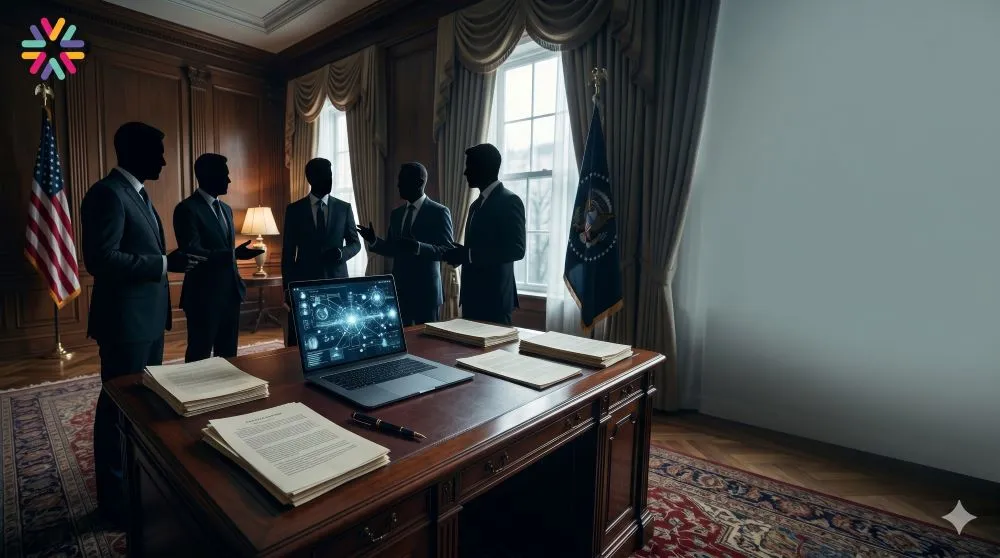
Artificial intelligence is no longer just a Silicon Valley story. It is now a White House story, a national security story, a jobs story, and a global power story.
That is why the sudden pause around the Trump AI executive order became one of the biggest U.S. tech policy moments of 2026. A planned White House signing was expected to signal a new approach to AI oversight, but last-minute objections from powerful technology leaders helped turn the moment into a dramatic political reversal.
Quick Answer: What Happened to the Trump AI Executive Order?
- The Trump AI executive order was expected to create a voluntary framework for government review of advanced AI systems before public release.
- The signing was canceled or postponed after concerns that the order could slow U.S. innovation and weaken America’s AI advantage.
- Silicon Valley leaders and investors reportedly warned that even voluntary oversight could become a de facto regulatory barrier.
- The debate reflects a larger conflict between AI safety, national security, business growth, and competition with China.
- The order may return in a revised form, but the episode shows how much influence the tech industry now has over U.S. AI policy.
Trump AI Executive Order: What Was the White House Trying to Do?
The planned Trump AI executive order was not designed as a traditional heavy-handed regulation. Based on reporting around the draft, the order would have created a voluntary system where major AI companies could share information about advanced models with the federal government before public release.
The central goal was security. Government officials have grown increasingly concerned that powerful AI systems could create new cybersecurity risks, support malicious activity, or expose vulnerabilities in critical infrastructure. A voluntary review system would have allowed federal agencies to examine certain models and identify possible dangers before the technology reached the public market.
Supporters saw the proposal as a practical middle ground. It would not formally ban products, require a licensing system, or impose a full approval process. It would instead encourage cooperation between AI developers and the government at a time when models are becoming more capable and more widely used.
But the tech industry saw a risk hidden inside the word “voluntary.” If the largest AI companies began submitting models to the government before release, that practice could quickly become the expected standard. Investors, smaller startups, and major platforms worried that a voluntary process could turn into an informal gatekeeping system.
That concern helped transform the order from a cybersecurity measure into a battle over the future of artificial intelligence regulation.
How Silicon Valley Leaders Changed the Conversation
The most important part of this story is not only that the order was delayed. It is how quickly the momentum shifted.
Leading figures from the tech world reportedly raised concerns that the draft order could slow product launches, create uncertainty, and hand an advantage to international competitors. Elon Musk’s AI lobbying became part of the wider discussion because he represents a unique mix of interests: AI development, platform ownership, infrastructure, government contracting, political influence, and public commentary.
Other technology executives and investors also had reasons to worry. Advanced AI companies compete on speed. A model that launches three months late can lose market share, developer attention, enterprise customers, and media momentum. Even a nonbinding government review could become a signal to buyers, investors, and rivals.
For Silicon Valley, the fear was simple: once Washington creates a review pathway, companies may feel pressured to use it. Once companies use it, skipping it may look irresponsible. Once skipping it looks irresponsible, the voluntary system starts behaving like regulation.
That is why the pushback mattered. It did not only object to one executive order. It challenged the idea that the federal government should have early access to powerful AI models before release.
Why the Issue Is Trending in the United States
This story is trending because it sits at the center of several national anxieties at once.
First, Americans are excited about AI but also worried about its consequences. AI tools are now used for writing, coding, customer service, education, advertising, research, hiring, image generation, and workplace automation. The technology feels useful, but it also raises questions about jobs, privacy, bias, fraud, misinformation, and security.
Second, Washington is trying to balance innovation with oversight. The United States wants to remain the global leader in artificial intelligence, especially as competition with China intensifies. But leadership does not only mean building the fastest models. It also means setting credible standards for safety, reliability, cybersecurity, and public trust.
Third, Silicon Valley’s political power has become more visible. Tech leaders are no longer simply reacting to federal policy. They are helping shape it in real time. The AI executive order episode showed how quickly industry pressure can influence a major White House decision.
Finally, the story matters because AI regulation is still unsettled. Congress has not created a comprehensive national AI law. States are experimenting with their own rules. Federal agencies are trying to adapt old frameworks to new tools. In that uncertainty, executive orders become powerful policy signals.
Why This Matters Right Now
The sudden collapse or delay of the order matters because it reveals the core tension in US tech policy 2026: America wants AI speed and AI safety at the same time.
For consumers, the issue affects how quickly new AI tools reach the market and how much confidence people can have in them. If models are released with minimal review, innovation moves faster. But risks may also surface after deployment, when millions of users are already exposed.
For businesses, the stakes are enormous. Companies want clear rules before investing in AI systems for customer service, finance, legal work, healthcare, education, and cybersecurity. Too much regulation can slow adoption. Too little can increase liability and reputational risk.
For startups, uncertainty is especially difficult. Large companies can afford compliance teams, policy experts, lobbyists, and security audits. Smaller companies may struggle if voluntary safety frameworks become the unofficial price of credibility.
For policymakers, the challenge is even harder. AI models are evolving faster than traditional lawmaking. A rule written today may feel outdated in a year. That makes the government more dependent on flexible frameworks, industry cooperation, and executive action.
Artificial Intelligence Regulation: Key Sides of the Debate
| Issue | Pro-Oversight View | Pro-Innovation View | Why It Matters |
|---|---|---|---|
| Pre-release model review | Helps identify cybersecurity and national security risks before public launch | Could delay releases and create an informal approval system | Determines how much access government should have to frontier AI systems |
| Voluntary safety frameworks | Flexible enough to encourage cooperation without strict mandates | May become mandatory in practice if markets expect participation | Affects startups, investors, and product launch timelines |
| U.S. competitiveness | Trustworthy AI can strengthen long-term leadership | Slow regulation may benefit China and other competitors | Frames AI as both an economic and geopolitical race |
| Public trust | Oversight can reassure users, businesses, and agencies | Excessive government involvement may reduce confidence in neutrality | Trust affects adoption in schools, workplaces, and public services |
| Industry influence | Companies understand technical risks better than many regulators | Powerful firms may shape rules to protect their own interests | Raises questions about who really writes AI policy |
The Role of Elon Musk AI Lobbying
Elon Musk AI lobbying is important because Musk sits on multiple sides of the AI debate. He has warned about AI risks for years, but he also operates companies that depend on fast-moving technology development. That makes his position more complex than a simple pro-regulation or anti-regulation label.
In this case, the reported concern was not necessarily that AI safety is unimportant. The concern was that the proposed order could give government agencies too much influence over model release timelines. For companies building frontier AI systems, timing is strategic. A delay can affect enterprise contracts, developer ecosystems, investor confidence, and competitive positioning.
Musk’s influence also matters because he has a direct line to both technology audiences and political audiences. When someone with that level of visibility pushes back against a policy idea, it can reshape the conversation quickly.
Still, the story is not only about Musk. Silicon Valley news coverage around the order also involved broader concerns from executives, investors, and policy insiders who believe the United States should avoid rules that resemble pre-market approval for AI.
Risks, Concerns, and Opposing Views
The biggest risk of stopping the order is that the United States may lose a chance to build an early-warning system for powerful AI models. Cybersecurity threats are not theoretical. Advanced models could help attackers find vulnerabilities, automate scams, generate persuasive misinformation, or support harmful technical activity.
Supporters of oversight argue that government review does not have to be anti-innovation. A well-designed voluntary framework could create trust, reduce surprise risks, and help agencies prepare for dangerous capabilities before they spread widely.
On the other side, critics argue that Washington often turns soft rules into hard expectations. They worry that a voluntary process could become a bottleneck, especially if agencies lack the technical speed to evaluate advanced models quickly. They also fear that large incumbents could absorb the burden while smaller startups fall behind.
There is also a political concern. If AI policy is shaped mostly by the biggest companies, public interest may be underrepresented. Workers, educators, civil rights groups, small businesses, and consumers also have stakes in how AI is governed.
The fairest reading is that both sides have valid concerns. AI needs safety thinking, but safety frameworks must not become slow, opaque, or captured by the largest players.
What Readers Should Do Now
For general readers, the most useful step is to understand that AI policy will affect everyday life. This is not only a debate for engineers or lobbyists. It can shape the tools used in hiring, banking, education, healthcare, search, social media, customer support, and public services.
Readers should watch for three things.
First, watch whether the executive order returns in a revised form. A delay does not mean the idea is dead. The White House may narrow the order, change the agencies involved, or redesign the voluntary framework.
Second, watch how major AI companies respond. If they voluntarily create their own safety review systems, government pressure may become less direct. If they resist transparency, policymakers may push harder later.
Third, watch Congress and state governments. Federal executive orders can shift quickly, but durable AI regulation may eventually require legislation. In the meantime, states may continue passing their own AI laws, creating a patchwork that businesses and consumers must navigate.
For businesses using AI, the lesson is practical: do not wait for Washington to settle everything. Create internal AI policies now. Track where AI is used, how outputs are reviewed, what data goes into systems, and who is responsible when tools fail.
Future Outlook: US Tech Policy 2026 and Beyond
The future of US tech policy 2026 will likely involve smaller, more targeted AI rules instead of one sweeping framework. That may include cybersecurity standards, federal procurement rules, model testing partnerships, export controls, workforce policies, infrastructure incentives, and agency-specific guidance.
The White House may also try to build cooperation with AI companies through informal agreements rather than formal mandates. This approach is faster and less politically explosive, but it can also be less transparent.
Another likely trend is the rise of AI governance as a business requirement. Even without a strict federal law, companies buying AI tools may demand audits, safety documentation, data protections, and reliability testing. Market pressure can sometimes regulate faster than government.
At the same time, the public debate will become sharper. Workers worried about automation, parents worried about schools, creators worried about copyright, and national security officials worried about cyber threats will keep demanding answers.
The blocked or delayed executive order is not the end of artificial intelligence regulation. It is a preview of how every major AI policy fight may unfold: fast, technical, political, and heavily influenced by the companies building the tools.
FAQ: Trump AI Executive Order and Silicon Valley Pushback
What was the Trump AI executive order supposed to do?
The planned order was expected to create a voluntary framework for advanced AI companies to share information about new models with the federal government before release, mainly to assess cybersecurity and national security risks.
Why did Silicon Valley leaders oppose the AI order?
Many tech leaders worried that even a voluntary review system could become a de facto approval process, slowing innovation, complicating launches, and weakening U.S. competitiveness against global rivals.
Was the AI executive order permanently canceled?
The order was canceled or postponed before the signing ceremony, but it may return in a revised form. The broader debate over AI oversight is still active.
How does this affect everyday Americans?
AI policy can affect the tools people use at work, school, healthcare offices, banks, customer service platforms, and social media. The rules will shape how safe, fast, transparent, and accountable those tools become.
What is the biggest challenge in artificial intelligence regulation?
The biggest challenge is balancing innovation with protection. The United States wants to lead the AI race while also reducing risks related to cybersecurity, misinformation, privacy, bias, jobs, and national security.
Conclusion: The AI Fight Has Moved From Labs to Power Rooms
The fight over the Trump AI executive order shows that artificial intelligence policy is now being shaped at the highest levels of power. The debate is not simply whether AI is good or bad. It is about who gets to decide how fast it moves, how closely it is watched, and what risks the country is willing to accept.
The most important lesson is that Silicon Valley no longer waits for Washington to regulate. It intervenes, negotiates, pressures, and reshapes the outcome while policy is still being written.
“RankAshva editorial view is that the paused AI order reveals the new reality of American power: the future of technology is no longer decided after innovation happens, but in the tense hours before the rules are signed.”
Whether the order returns or disappears, the message is clear. Artificial intelligence regulation will be one of the defining policy battles of 2026, and the next round may arrive sooner than the public expects.


More Stories
Why the U.S. Government Ordered Restrictions on Anthropic’s Claude Fable 5 and Mythos 5
PURSUE UFO Files: The Truth Behind the May 2026 Declassified Videos
What is Cockroach Janta Party? Founder, Agenda and the Story Behind Its 20M Instagram Buzz