
Introduction
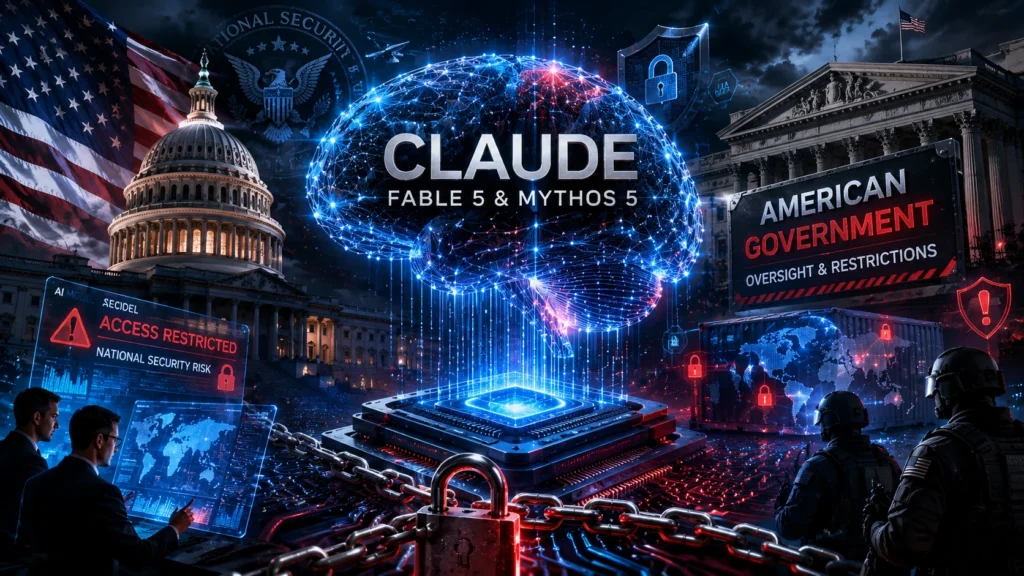
Anthropic’s Claude Fable 5 and Mythos 5 have reportedly become part of a major and growing debate around AI safety, U.S. export controls, national security, and responsible AI regulation. According to available reports, the U.S. government is said to have ordered restrictions on access to these advanced AI systems — a move that has triggered significant discussion across the technology industry, policy circles, and among everyday users.
But this issue is far bigger than one company or two AI models. It raises a question that every government, every business, and every citizen may soon need to answer:
Who should control access to powerful AI systems when they can help society but may also create serious national security risks?
This blog post breaks down the reported restrictions in plain language — explaining what these models reportedly do, why the government may have acted, what dangers officials appear to have identified, and how ordinary people could have benefited from this technology. Whether you are a student, a business owner, a developer, or simply someone curious about AI, this article is written for you.
Please note: This article uses careful, hedged language throughout because official government documentation regarding these specific models may be limited or partially disclosed. All claims are presented with appropriate qualifications.
What Are Claude Fable 5 and Mythos 5?
To understand why the U.S. government reportedly stepped in, it helps to first understand what Claude Fable 5 and Mythos 5 are said to be. According to available information, these are described as advanced frontier AI models developed by Anthropic, a leading AI safety company based in San Francisco.
Unlike basic chatbots that answer simple questions, frontier AI models are considerably more powerful. They can reason through complex problems, write sophisticated code, analyze large datasets, and engage in detailed, multi-step conversations. Think of them as the difference between a pocket calculator and a supercomputer — both compute numbers, but at vastly different scales of capability.
What Can These Models Reportedly Do?
Based on the general capabilities associated with frontier AI systems of this type, Claude Fable 5 and Mythos 5 may reportedly assist with:
- Writing and content creation — drafting articles, reports, scripts, and creative content
- Software coding and debugging — helping developers write, test, and fix code
- Academic and professional research — summarizing documents, identifying patterns in data
- Cybersecurity analysis — identifying vulnerabilities and suggesting defense strategies
- Business productivity — automating reports, emails, and planning tasks
- Education and tutoring — explaining complex subjects in simple terms
- Data analysis and reasoning — drawing conclusions from large and complex information sets
- Language translation and communication — assisting users across multiple languages
The term “frontier AI” is important here. It means these systems operate at or near the cutting edge of what AI can currently do. That combination of power and breadth of capability is precisely what makes them valuable — and, according to some officials, potentially concerning.
Why Did the U.S. Government Order Restrictions?
According to available reports, the U.S. government’s decision to order restrictions on Anthropic’s Claude Fable 5 and Mythos 5 appears to be rooted in several intersecting concerns — none of which are entirely new, but all of which have grown more urgent as AI capabilities advance rapidly.
The concerns reportedly include:
- Export-control rules — The U.S. has strict laws about exporting sensitive technology to foreign nations, particularly those considered adversarial. Advanced AI models may have been classified under these rules.
- Foreign access risks — Officials may have worried that foreign nationals, foreign companies, or state-backed actors could access these models and extract strategically valuable capabilities.
- National security concerns — Powerful AI that can assist with research, coding, or cybersecurity may be seen as having dual-use potential — useful for defense, but equally useful for offense.
- Cybersecurity vulnerabilities — If these models could assist with offensive cyber operations or help bad actors identify weaknesses in government or corporate systems, that risk may have alarmed officials.
- Potential jailbreak vulnerabilities — Reportedly, concerns may have existed that safety guardrails in these models could be bypassed, potentially allowing misuse at scale.
- Misuse by hostile or criminal groups — The concern appears to be that cybercriminals, disinformation networks, or hostile state-backed groups could weaponize these models.
It is important to note that the U.S. government reportedly did not view the AI models themselves as inherently dangerous. Rather, officials may have worried about how such powerful technology could be misused once it moves outside controlled environments.
What Threat Did the U.S. Government See?
This is perhaps the most important section to understand clearly. Governments rarely act against a technology simply because it exists. The concern, according to available reports, appears to be about the potential for misuse at scale — not the technology in isolation.
“A powerful AI model is like a powerful engine. It can run an ambulance, a school bus, or a rescue vehicle. But in the wrong hands, the same power can be used in harmful ways.”
If these concerns are accurate, officials may have identified the following potential threat scenarios:
Cybersecurity-Related Threats
- Automated hacking support — A highly capable model could potentially guide bad actors through cyberattack processes step by step
- Phishing campaigns — AI could generate highly convincing and personalized phishing emails at scale
- Malware-related assistance — Coding-capable models might assist in the creation or refinement of malicious software if safety guardrails fail
- Data theft planning — AI could help attackers identify targets, map networks, or analyze leaked data
Information and Influence Threats
- Disinformation campaigns — Generating convincing fake news, false narratives, or propaganda at scale
- Election manipulation — Producing targeted messaging designed to influence public opinion or suppress voter participation
- Government impersonation — Creating fake official documents, emails, or communications that appear legitimate
Strategic and Infrastructure Threats
- Military or intelligence misuse — Potentially assisting foreign intelligence services in analyzing sensitive data or planning operations
- Attacks on public infrastructure — AI-assisted targeting of power grids, water systems, financial networks, or hospital systems
- Supply-chain targeting — Helping adversaries identify vulnerabilities in defense contractors or government supply chains
It must be emphasized that these are potential concerns raised in the context of restrictions, not confirmed events. The government’s concern appears to be preventive rather than reactive to a specific confirmed incident.
Was This a Ban or an Export-Control Restriction?
Many readers may have encountered headlines using words like “banned” or “blocked” when describing government action on AI models. It is worth clarifying what these terms actually mean — because the distinction matters significantly for both the public and for businesses.
| Term | Meaning | How It Applies Here |
|---|---|---|
| Ban | A complete prohibition on use, access, or distribution | Use this term only if official sources explicitly confirm a complete ban |
| Restriction | Limited access under certain conditions or rules | Likely more accurate for export-control or access-limitation cases |
| Suspension | A temporary pause in access or availability | May apply if access was disabled on a time-limited basis pending review |
| Export Control | Rules that limit the transfer of sensitive technology to foreign entities | Appears to be the central legal mechanism in this reported case |
Many people may search online for an “AI ban” when trying to understand this issue. However, the more accurate and legally precise term may be “export-control restriction” or simply “access restriction.” This distinction matters because a restriction typically allows domestic use to continue under specific rules, while a complete ban would halt all access entirely.
Unless official government documentation explicitly uses the word “ban,” it is more responsible — and more accurate — to describe this situation as a restriction or export-control action.
How Could These AI Models Help Ordinary People?
Beyond the government and security debates, it is crucial to remember that advanced AI models like Claude Fable 5 and Mythos 5 — if the reported capabilities are accurate — have the potential to create real, practical benefits for millions of everyday users.
“For ordinary people, advanced AI is not just futuristic technology. It can become a practical assistant for learning, working, creating, and solving everyday problems.”
Here are real-world examples of how such models could benefit ordinary users:
- Students can ask complex questions in plain language and receive clear, detailed explanations — making difficult subjects like physics, history, or coding far more accessible.
- Small business owners can generate marketing plans, write product descriptions, or analyze customer feedback without hiring expensive consultants.
- Software developers can debug broken code, generate boilerplate functions, and get suggestions for improving their programs faster than ever before.
- Writers and content creators can brainstorm article ideas, overcome writer’s block, and refine their drafts with AI-assisted feedback.
- Researchers and academics can summarize lengthy papers, identify key findings, and cross-reference information across large document sets in minutes.
- Cybersecurity professionals can use AI to detect weaknesses in their systems, simulate threat scenarios, and build stronger defenses.
- Customer support teams can respond to customer queries faster, more consistently, and in multiple languages — improving customer experience.
- Non-technical everyday users can use AI as a general productivity assistant — for drafting emails, planning schedules, researching products, or learning new skills.
This is why the restrictions have sparked debate not just among governments and companies, but among educators, entrepreneurs, and innovators who see enormous positive potential in these systems — potential that may be delayed or limited by access restrictions.
What Is an AI Jailbreak?
One of the concerns reportedly connected to the restrictions on these models involves the concept of AI jailbreaking. This term sounds technical but can be explained simply.
An AI jailbreak is an attempt to trick an AI system into ignoring its built-in safety rules and producing content it should normally refuse to generate.
AI companies like Anthropic invest heavily in building safety guidelines into their models. These guidelines prevent the AI from producing harmful content — such as instructions for dangerous activities, content that violates laws, or material that could be used to harm others. A jailbreak is essentially an attempt to find a backdoor around these protections.
How Jailbreaks Are Typically Attempted (Overview Only)
- Role-play manipulation — Asking the AI to pretend it is a different, unrestricted AI without safety rules
- Fictional framing — Embedding a harmful request inside a story or hypothetical scenario to bypass content filters
- Indirect prompting — Rephrasing a restricted request in ways that the safety filters may not immediately recognize
- Policy confusion — Trying to convince the model that its own safety policies have been updated or removed
This section provides awareness-level information only. No specific jailbreak methods, techniques, or exploits are described or encouraged anywhere in this article.
AI companies continuously update their models to close known jailbreak vulnerabilities. However, with increasingly powerful models, the stakes of any successful jailbreak also increase — which is why this issue reportedly became a factor in the government’s review of Claude Fable 5 and Mythos 5.
Could Jailbreaks Create a Government-Level Risk?
A jailbreak does not automatically mean that an AI model is broadly dangerous. The vast majority of users never attempt to jailbreak an AI, and most jailbreak attempts — according to AI safety researchers — are limited in scope and quickly patched. However, if a highly capable model could be repeatedly and reliably manipulated, that could become a more serious concern.
Why Jailbreaks May Concern Governments
- Bad actors could seek cyber guidance — Even general guidance on vulnerabilities could be valuable to hostile groups if safety filters are bypassed
- Criminals could scale fraud operations — A jailbroken model could potentially help generate fake identities, fraudulent documents, or social engineering scripts
- Disinformation networks could weaponize content — Jailbroken models could produce highly persuasive, false narratives faster and more cheaply than human teams
- Hostile groups could accelerate harmful research — In extreme scenarios, officials may have worried about AI-assisted research in sensitive or restricted domains
- Attacks on institutions could be scaled — Automated phishing, impersonation, or intrusion support could overwhelm unprepared public institutions
The Other Side of the Argument
- AI companies conduct red-teaming — Anthropic and other leading AI companies employ teams specifically tasked with finding and fixing vulnerabilities before deployment
- Many jailbreak claims are overstated — Not every reported jailbreak creates a meaningful or catastrophic security risk; many are more theoretical than practical
- No single jailbreak enables mass harm automatically — A successful jailbreak still requires a human actor with intent, access, and resources to cause real-world damage
- Government decisions should be evidence-based — Restricting technology based on hypothetical risks rather than demonstrated harms can itself create unintended negative consequences for innovation
Could Some People Misuse These Models Against Governments?
This is a balanced and important question. The honest answer, according to security researchers and policy experts, is: potentially yes, if safeguards fail. But it is equally important to state clearly that the mere existence of a powerful AI model does not make misuse inevitable or even likely for most use cases.
At a high level, security experts have discussed the following possible misuse scenarios in the context of advanced AI models:
Possible Misuse Against Governments or Companies
- Cyberattacks against government systems — AI-assisted identification of weaknesses in government networks, databases, or critical infrastructure
- Fake government communications — Generating convincing fake emails, letters, or announcements that impersonate officials or agencies
- Election-related disinformation — Producing large volumes of targeted, persuasive false content designed to manipulate voters or undermine electoral trust
- Automated propaganda — Generating and distributing state-level or political propaganda with minimal human effort
- Intelligence gathering assistance — Using AI to rapidly analyze and synthesize publicly available information for adversarial intelligence purposes
- Attacks on government contractors — Targeting the supply chain of government services through AI-assisted social engineering or phishing
This section is for public awareness and policy discussion purposes only. No instructions, methods, or encouragement of any harmful activities are provided or implied.
The policy goal, according to most AI safety experts, should not be to eliminate AI out of fear — but to build strong safeguards, transparency mechanisms, and accountability frameworks that make misuse difficult, detectable, and prosecutable.
Pros and Cons of Restricting Advanced AI Models
Restricting powerful AI models is not a simple or cost-free decision. There are legitimate arguments on both sides of the debate.
✅ Pros of Restrictions
- Protects national security from hostile actors
- Reduces access for foreign adversaries and criminal groups
- Gives regulators time to properly review AI risks
- Encourages AI companies to conduct stronger safety testing
- Builds public trust in responsible AI deployment
- Prevents uncontrolled global access to cutting-edge capabilities
❌ Cons of Restrictions
- May slow AI innovation and competitive advantage
- Could negatively affect legitimate researchers and businesses
- Creates regulatory uncertainty for AI developers and investors
- May limit access for ordinary users who benefit from AI tools
- Could push AI development into less transparent or less safety-conscious environments
- Risk of conflating safety concerns with censorship of useful technology
Benefits vs. Risks by Use Area
The following table summarizes the balance of public benefits and possible risks across key sectors:
| Area | Public Benefit | Possible Risk |
|---|---|---|
| Education | Personalized learning, accessible tutoring for all levels | Misinformation or academic dishonesty if unchecked |
| Business | Faster productivity, lower operational costs for small businesses | Potential for spam, fraud, or market manipulation |
| Cybersecurity | Stronger defense tools, faster vulnerability detection | Offensive misuse if safety guardrails are bypassed |
| Research | Faster data analysis and document summarization | Possible misuse of sensitive or dual-use knowledge |
| Government | Better, faster public services and citizen assistance | Security concerns and potential surveillance misuse |
| Media | Faster content creation, broader reach for independent creators | Disinformation and propaganda at unprecedented scale |
What This Means for the Future of AI Regulation
The reported restrictions on Anthropic’s Claude Fable 5 and Mythos 5 may turn out to be more than an isolated government action. They may represent an early signal of a broader shift: one in which advanced AI models are increasingly treated as strategic national assets — similar to advanced semiconductors, military technologies, or sensitive research data.
Several important policy questions emerge from this case:
- Should governments have stronger oversight of frontier AI releases before they become publicly accessible?
- Should AI companies be required to demonstrate safety through independent audits before deploying advanced models?
- Should export-control frameworks be updated to explicitly and consistently include advanced AI systems?
- How can governments balance innovation with security — ensuring restrictions do not simply push AI development to less accountable environments?
- Why does transparency matter? When governments restrict technology without clear public explanation, it creates confusion, rumors, and distrust — making it harder for ordinary users and businesses to plan ahead.
Ordinary users should care about these questions because the decisions made now will shape what AI tools are available to them in the future — and under what conditions. AI regulation is not just a government issue. It is a society-wide issue.
“The future of AI regulation will depend on one difficult balance: keeping powerful technology open enough to help society, but controlled enough to prevent serious harm.”
Conclusion
The reported restrictions on Anthropic’s Claude Fable 5 and Mythos 5 illustrate something important: advanced AI is no longer simply a technology product. It is becoming simultaneously a national security issue, a business issue, a public safety issue, and a human empowerment issue.
These models reportedly had the potential to help students learn faster, help small businesses compete, help developers build better software, and help researchers solve problems that once required entire teams. That potential is real, and it should not be dismissed or minimized in the rush to address security concerns.
At the same time, if these concerns are accurate — if advanced AI can be reliably jailbroken or misused by hostile actors — then governments face a genuine responsibility to act. The question is not whether to act, but how to act wisely, transparently, and proportionately.
The real challenge is not simply whether powerful AI should be allowed or banned. The real challenge is creating rules that make AI safe, useful, transparent, and accountable. That challenge belongs not only to governments and AI companies — but to all of us.
Frequently Asked Questions (FAQs)
1. Why did the U.S. government restrict Anthropic’s Claude Fable 5 and Mythos 5?
According to available reports, the concern appears to be related to a combination of national security concerns, export-control rules, risks of foreign access to advanced AI capabilities, cybersecurity risks, and the potential for misuse by hostile actors. The government may not have viewed the models themselves as inherently dangerous, but reportedly worried about what could happen if powerful AI capabilities fell into the wrong hands.
2. Were Claude Fable 5 and Mythos 5 completely banned?
The word “ban” implies a complete prohibition. Based on available information, the more accurate term appears to be “restriction” or “export-control action” — meaning access was limited under certain rules rather than entirely eliminated. Unless official government sources explicitly confirm a complete ban, it is more accurate to describe this as a targeted access restriction.
3. What is an AI jailbreak?
An AI jailbreak is an attempt to trick an AI system into bypassing its built-in safety rules and producing content it would normally refuse to generate. This is typically done through clever prompting techniques, role-play manipulation, or indirect framing of requests.
4. Why are AI jailbreaks considered dangerous?
Jailbreaks may allow users to extract restricted or unsafe responses from an AI model. With a more powerful model, the potential harm from a successful jailbreak is greater — since the AI’s capabilities are broader and more sophisticated. This is why jailbreak resistance is treated as a key safety criterion for frontier AI models.
5. How could Claude Fable 5 and Mythos 5 help ordinary people?
If the reported capabilities are accurate, these models could assist with education, coding, writing, business productivity, research, cybersecurity defense, and general daily tasks. Students, entrepreneurs, developers, writers, and researchers could all benefit significantly from access to such systems.
6. Could bad actors misuse advanced AI models?
Potentially yes, if safeguards fail. At a high level, possible misuse scenarios include cyber fraud, phishing campaigns, disinformation creation, and impersonation of officials or institutions. However, misuse is not inevitable — strong safety measures, red-teaming, and responsible deployment practices significantly reduce these risks.
7. Why does the U.S. government care about foreign access to AI models?
Governments may worry that foreign adversaries or hostile groups could use advanced AI capabilities to conduct cyberattacks, gather intelligence, spread disinformation, or undermine national security infrastructure. This is similar to why the U.S. has historically controlled exports of advanced semiconductors, military technology, and sensitive research.
8. What does this case mean for the future of AI regulation?
This case may signal that governments will increasingly treat frontier AI models as strategic technology subject to export controls, safety audits, and access restrictions. Future regulation may require AI companies to demonstrate safety before deployment, submit to independent audits, and comply with updated export-control frameworks — all while trying to preserve innovation and public access.
— RankAshva Magazine



More Stories
PURSUE UFO Files: The Truth Behind the May 2026 Declassified Videos
Inside the Oval Office: How Silicon Valley Leaders Stopped the 2026 AI Executive Order
What is Cockroach Janta Party? Founder, Agenda and the Story Behind Its 20M Instagram Buzz