
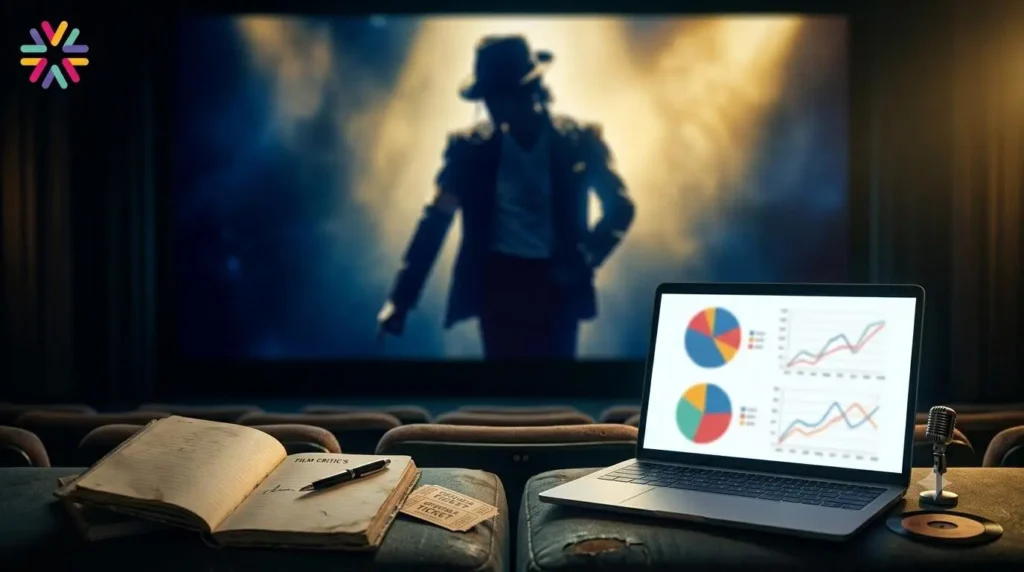
Some movies open big. Others become cultural events.
Antoine Fuqua’s Michael has done something rare: it turned a music biopic into a full-scale box office phenomenon. With more than $700 million worldwide, a massive domestic run for Lionsgate, and intense debate around its storytelling choices, the film is not just being watched. It is being argued over.
That raises the question driving fans, critics, and Hollywood insiders right now: is Michael the greatest music biopic ever, or simply the most powerful box office story of 2026?
Quick Answer: Is Michael the Greatest Music Biopic Ever?
- Commercially, Michael is already one of the biggest music biopics ever, crossing more than $700 million worldwide.
- Jaafar Jackson’s performance is the film’s strongest asset, giving the movie emotional power and stage authenticity.
- Critics remain divided, especially over whether the film avoids the most difficult parts of Michael Jackson’s life.
- Audiences have responded far more warmly than many critics, helping the movie show strong box office staying power.
- The best answer is nuanced: Michael may be a historic crowd-pleaser, but “greatest” depends on whether viewers value spectacle, honesty, artistry, or cultural impact most.
Michael Jackson Biopic Movie Review: Why Michael Became a 2026 Entertainment Event
A proper Michael Jackson biopic movie review has to look beyond ticket sales. The movie’s commercial performance is extraordinary, but the conversation around it is more complicated than a simple hit-or-flop headline.
Directed by Antoine Fuqua and starring Jaafar Jackson as his late uncle, Michael focuses on Jackson’s rise from child performer to global pop icon. The film leans into performance, ambition, family pressure, music industry machinery, and the visual language that made Jackson one of the most recognizable entertainers in history.
For many moviegoers, the appeal is immediate. The songs are familiar. The choreography is iconic. The costumes, lighting, and concert recreations are designed to trigger memory and emotion. A viewer does not need to be a film scholar to understand why crowds are showing up.
But Michael is also controversial because Michael Jackson’s legacy is controversial. Any film about him must decide how to handle fame, genius, childhood trauma, physical transformation, media pressure, and the serious allegations that shaped later public discussion around his life.
That is where the film becomes more than entertainment. It becomes a test of what audiences expect from celebrity biopics in 2026.
What Is Happening at the Box Office?
The biggest story is the number: Michael has crossed more than $700 million globally. That puts it in rare territory for any music biopic and makes it one of the defining theatrical hits of 2026.
The Antoine Fuqua Michael movie box office run has been especially notable because the film did not simply open big and disappear. It held audience attention across multiple weekends, returned to the top spot in North America, and continued drawing international viewers.
The Lionsgate Michael movie domestic gross has also become a major industry talking point. For a studio release in a theatrical market still shaped by streaming competition, superhero fatigue, franchise risk, and unpredictable audience behavior, a domestic total approaching the high hundreds of millions is a powerful statement.
Internationally, the film’s strength makes sense. Michael Jackson was not only an American superstar. He was a global figure. His music, dance, image, and mythology traveled across language, age, and geography. That global recognition gives the movie an advantage many biopics do not have.
Still, a $700 million run does not automatically make a movie the best in its genre. It makes it impossible to ignore.
Why Michael Is Trending Right Now
The film is trending for four main reasons.
First, the box office is historic. Music biopics rarely reach this level. Most perform well with older audiences, fans, and awards-season viewers, but few become full global blockbusters.
Second, the film has a built-in generational audience. Older fans remember Jackson’s dominance in real time. Younger fans know the songs through TikTok, streaming, YouTube, family playlists, and pop culture references.
Third, Jaafar Jackson’s casting gives the movie a unique emotional hook. His resemblance, movement, and family connection make the performance feel different from a standard impersonation.
Fourth, the criticism has made the movie more discussed, not less. Some viewers see it as a powerful tribute. Others see it as a selective portrait. That tension has kept the conversation alive long after opening weekend.
In the modern entertainment economy, debate can be part of momentum. A film that people love, question, defend, and criticize often stays visible longer than a film people simply like.
Why It Matters Right Now
For U.S. audiences, Michael matters because it sits at the center of several major entertainment trends.
One trend is the return of the theatrical music event. In a streaming-heavy culture, people still show up for big-screen musical nostalgia when the subject is powerful enough. Concert films, biopics, documentaries, and legacy acts are proving that music can still move box office numbers.
Another trend is the rise of audience-versus-critic divides. Michael has been criticized for being safe, polished, and incomplete, yet general audiences have responded strongly. That gap matters because studios are watching which voices actually drive ticket sales.
There is also a business lesson. Hollywood often talks about franchise fatigue, but Michael shows that real-life icons can function like franchises when the cultural memory is deep enough. Songs become intellectual property. Costumes become visual branding. Dance moves become instantly recognizable marketing.
Socially, the movie matters because it raises a difficult question: how should popular culture remember complicated artists? Can audiences celebrate the work while still acknowledging the controversy? Should a biopic entertain first, investigate first, or try to do both?
Those questions are not limited to Michael Jackson. They apply to many artists, athletes, political figures, and celebrities whose legacies are both influential and contested.
Comparison: Michael vs. Other Major Music Biopics
| Film | Main Strength | Main Criticism | Why It Matters |
|---|---|---|---|
| Michael | Massive global box office, performance spectacle, Jaafar Jackson’s physical and emotional resemblance | Criticized for avoiding or minimizing difficult parts of Jackson’s later life | Shows how powerful global music nostalgia remains in theaters |
| Bohemian Rhapsody | Huge crowd appeal, iconic Queen music, awards-season momentum | Criticized for simplifying Freddie Mercury’s life and timeline | Set the modern commercial benchmark for music biopics |
| Elvis | Bold visual style, strong lead performance, high-energy direction | Some viewers found it excessive or too filtered through Colonel Parker | Proved theatrical audiences still wanted stylized music legends |
| Rocketman | Creative musical structure, emotional honesty, fantasy sequences | Less commercially massive than some competitors | Often praised as one of the more artistically daring music biopics |
| Straight Outta Compton | Cultural urgency, ensemble energy, strong social context | Debates over omitted or softened real-life events | Expanded the modern music-biopic audience and subject range |
Is Michael the Best Music Biopic of 2026?
Among the best music biopics of 2026, Michael is clearly the dominant commercial title. Its box office performance makes it the movie every other music biopic will be compared against this year.
But “best” is not the same as “biggest.”
If someone defines best as the most successful theatrical event, Michael has a strong case. If someone defines best as the most emotionally satisfying tribute, it also has a strong case for fans. If someone defines best as the most honest, complex, or formally daring portrait of an artist, the answer becomes less certain.
The film works best when it recreates the force of Jackson’s performance identity. The stage sequences, musical transitions, costume details, and physical movement carry the kind of energy audiences want from a movie about the King of Pop.
It works less well for viewers who want a deeper confrontation with the contradictions of fame, family, race, money, media, and allegation. For those viewers, the film may feel too careful.
That tension is the real review. Michael is not a small movie trying to discover a person quietly. It is a large, estate-shaped cultural production trying to restore the scale of a legend.
Risks, Concerns, and Opposing Views
The strongest criticism of Michael is that it may be too controlled. Authorized biopics often have access to music, family cooperation, and visual detail, but that access can come with limits.
Some critics argue that the movie acts more like a celebration than an investigation. They believe the film gives audiences the thrill of Jackson’s artistry while avoiding the hardest questions surrounding his legacy.
Supporters see it differently. They argue that a two-hour biopic cannot cover every chapter of a complicated life, especially when the film’s chosen focus is Jackson’s rise and creative peak. For them, the movie is not a courtroom document. It is a cinematic portrait of talent, pressure, ambition, and performance.
There is also a practical concern for viewers. People entering the theater may expect different movies. Fans may want a tribute. Critics may want a reckoning. Casual viewers may want a musical spectacle. No single film can fully satisfy all three expectations.
That is why the debate around Michael is not only about the movie. It is about what audiences believe a biopic owes to truth, legacy, and entertainment.
What Readers Should Do Before Watching
If you have not watched Michael yet, go in with the right expectations.
First, understand that the film is built as a theatrical experience. It is designed for sound, scale, performance, and emotion. If you care about music sequences and big-screen energy, a theater may be the best way to experience it.
Second, separate box office success from artistic judgment. A movie can be enormously popular and still flawed. A movie can be critically imperfect and still meaningful to audiences.
Third, read more than one review. Because the response is divided, a single opinion may not capture the full picture. Look at critic reviews, audience reactions, and box office trends together.
Fourth, revisit other music biopics. Watching Bohemian Rhapsody, Rocketman, Elvis, or Straight Outta Compton can help you understand what different biopic styles choose to emphasize.
Finally, approach the movie with curiosity. The question is not only whether it tells the whole truth. The question is what version of Michael Jackson the film wants audiences to remember.
Future Outlook: Could Michael Become the Biggest Music Biopic Ever?
The next major question is whether Michael can keep climbing toward the all-time record held by Bohemian Rhapsody. At more than $700 million worldwide, it is already close enough for the comparison to feel serious.
Its path forward depends on several factors: international legs, repeat viewings, competition from major summer releases, premium format demand, and whether debate continues to drive curiosity.
A sequel is also now part of the conversation. Because the film focuses heavily on Jackson’s rise and earlier career, there is room for a second movie that explores later years, greater controversy, and the cost of global fame. Whether that sequel happens will depend on creative choices, legal risk, audience appetite, and box office confidence.
For Hollywood, the lesson is already clear. Music biopics are not fading. If the artist has enough global recognition, the right performer, and a strong theatrical package, the genre can still compete with franchises.
“RankAshva editorial view is that Michael is less a final verdict on a complicated icon than a reminder of cinema’s power to turn memory into spectacle—beautiful, profitable, and still unfinished.”
FAQ: Michael Jackson Biopic Movie Review
Is Michael the highest-grossing music biopic ever?
Not yet. Michael has passed more than $700 million worldwide and is among the biggest music biopics ever, but Bohemian Rhapsody remains the benchmark it is chasing.
Who plays Michael Jackson in Antoine Fuqua’s Michael?
Jaafar Jackson, Michael Jackson’s nephew, plays the lead role. His performance has been one of the most praised elements of the movie, especially for its physical resemblance and stage movement.
Why is Michael controversial?
The film is controversial because it focuses strongly on Jackson’s rise, music, and performance legacy while critics argue it does not fully confront the most difficult allegations and later-life controversies connected to him.
How much has Michael made at the box office?
The film has passed more than $700 million worldwide, including a major domestic run for Lionsgate and strong international performance.
Should I watch Michael in theaters?
If you enjoy music films, concert-style sequences, and large-scale biopics, the theater experience is likely the best format. If you want a deeply investigative portrait, you may find the film more limited.
Conclusion
Michael is one of the most important entertainment stories of 2026 because it combines box office power, musical nostalgia, family legacy, controversy, and global audience emotion.
Is it the greatest music biopic ever? Commercially, it belongs in the conversation. As a performance-driven tribute, it is clearly powerful. As a complete portrait of a complicated artist, it remains open to debate.
The most honest verdict is this: Michael may not settle Michael Jackson’s legacy, but it has already changed the future of the music biopic. It proves that when a film captures the sound, image, and mythology of a global icon, audiences will still show up in massive numbers.



More Stories
The Devil Wears Prada 2: Why Miranda Priestly’s Audio Is Dominating TikTok
End of an Era: Inside Stephen Colbert’s Emotional ‘Late Show’ Series Finale
Netflix MMA Viewership 2026: How Ronda Rousey’s 17-Second Fight Changed Streaming Sports