
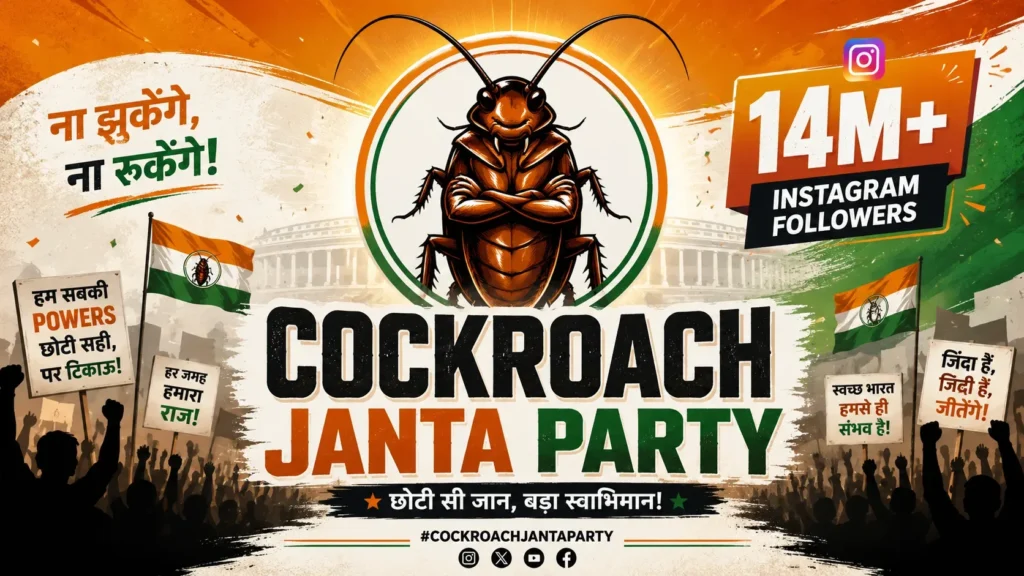
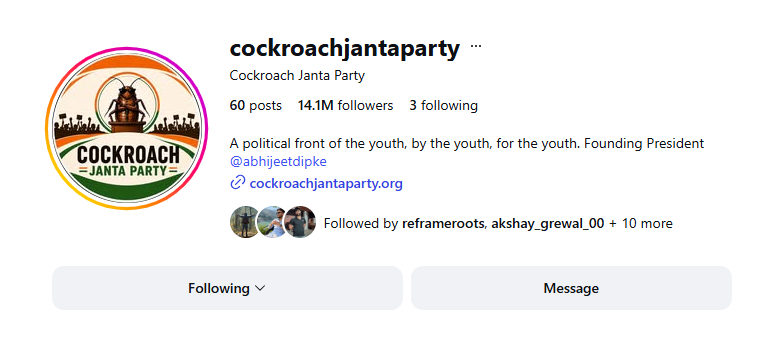
In an era where political parties spend years and crores of rupees to build a public following, a page called Cockroach Janta Party reportedly did something extraordinary — it crossed 20 million Instagram followers in approximately five days, according to viral screenshots and widespread media discussions. The name is deliberately absurd. The branding is unapologetically satirical. And yet, it has sparked one of the most talked-about conversations in Indian digital politics in recent memory.
So what exactly is the Cockroach Janta Party, commonly known as CJP? Is it a real political party preparing to contest elections? Is it a protest movement? Or is it simply the internet’s latest, most creative way of expressing frustration with the political establishment? This article breaks it all down — the founder, the agenda, the viral growth, and what it all actually means.
One thing is clear from the start: Cockroach Janta Party appears to be a viral satirical online political movement or campaign, not a traditional, registered, mainstream political party. Its power, at least for now, lives almost entirely on social media — and that in itself is a story worth telling.
📋 Table of Contents
- Quick Facts About Cockroach Janta Party
- Founder of Cockroach Janta Party
- What is the Agenda of Cockroach Janta Party?
- Why Did Cockroach Janta Party Go Viral?
- Is Cockroach Janta Party a Real Political Party or a Satirical Movement?
- What Does 20M Instagram Followers Really Mean?
- Impact on Indian Political Discourse
- Frequently Asked Questions (FAQs)
- Conclusion
Quick Facts About Cockroach Janta Party
| Detail | Information |
|---|---|
| Full Name | Cockroach Janta Party (CJP) |
| Type | Viral satirical online political movement/campaign |
| Founder (as reported) | Abhijeet Dipke |
| Platform | Primarily Instagram; also reportedly active on X (Twitter) |
| Reported Followers | ~20 million on Instagram (as per viral screenshots; subject to change) |
| Time to Viral Growth | Reportedly approximately 5 days |
| Tagline / Positioning | “Voice of the Lazy & Unemployed” (as reported in media) |
| X (Twitter) Status | Account reportedly restricted/withheld in India |
| Registered Political Party? | No credible evidence of formal registration with Election Commission of India |
| Main Focus | Political satire, youth frustration, anti-establishment digital commentary |
Founder of Cockroach Janta Party
According to media reports and discussions circulating online, the person behind the Cockroach Janta Party is Abhijeet Dipke. Reports describe him as someone with a background in political communication and social media strategy. He is also reportedly associated with past digital campaign work linked to the Aam Aadmi Party (AAP), though the exact nature and extent of this association has not been independently verified at the time of writing.
What makes Dipke’s project notable is not just the name or the shock value — it is the apparent understanding of how internet virality works. The branding is deliberately provocative: a cockroach, one of the most universally disliked insects, is used as a metaphor. It positions the movement as something that cannot be easily ignored or exterminated, surviving every condition — much like the frustrations of India’s unemployed youth.
As per media discussions, Dipke appears to have designed CJP less as a conventional political entity and more as a digital protest platform — using satire, meme culture, and pointed political commentary to generate attention and conversation. RankAshva readers and others following Indian digital trends would recognize this as a now-familiar playbook in internet-age activism.
What is the Agenda of Cockroach Janta Party?
Despite its comedic name, the CJP agenda contains points that are politically specific and, in many cases, address real concerns raised by critics of the Indian political system. The manifesto appears to be satirical in tone but politically pointed in substance. Here are the key agenda points reported in media coverage:
- No Rajya Sabha seat for retired Chief Justices — A pointed jab at the practice of appointing recently retired senior judges to the Upper House of Parliament, which critics argue compromises judicial independence.
- Strict action if legitimate votes are deleted — Addressing concerns around electoral roll deletions, a topic that has repeatedly sparked controversy and public debate in India.
- 50% reservation for women in Parliament and 50% Cabinet representation — A demand for meaningful gender parity in political leadership, going beyond symbolic gestures.
- Action and investigation against “godi media” — A criticism of corporate-owned media outlets perceived as biased toward the ruling establishment. The term “godi media” (meaning “lap media”) is widely used in Indian political discourse as a pejorative.
- A long ban on MLAs and MPs who switch parties — Targeting the widespread practice of political defection, popularly called “aaya ram gaya ram” politics, where legislators change parties for personal gain.
These points are not random. They tap into issues that genuinely frustrate large sections of the Indian public — particularly young, educated, and politically aware voters. Whether presented seriously or satirically, the agenda has clearly resonated with a significant online audience.
“CJP is not just being discussed as a party; it is being discussed as an internet reaction.”
Why Did Cockroach Janta Party Go Viral?
Virality rarely happens by accident, and CJP’s explosive growth appears to be the result of several converging factors. Below is a breakdown of the most likely reasons, along with one important caveat.
| Reason | Explanation |
|---|---|
| Shock-value name and branding | The name “Cockroach Janta Party” is impossible to ignore. It triggers curiosity instantly — people share it just to show others. |
| Meme-friendly political satire | The content is designed to be screenshot-worthy and shareable, fitting natively into India’s thriving political meme culture. |
| Youth unemployment and frustration | The tagline “Voice of the Lazy & Unemployed” directly speaks to millions of young Indians facing joblessness, dismissal by the system, or a sense of being mocked by those in power. |
| Anti-establishment sentiment | At a time of high political polarization, CJP offered a way to express discontent without aligning with any existing party. |
| Headline comparison with BJP | Reports that CJP’s follower count surpassed the BJP’s official Instagram page turned a funny internet moment into a media-worthy story. |
| Influencer and social media amplification | Once key accounts began sharing CJP content, the snowball effect took over, pushing it to wider audiences rapidly. |
| X account restriction in India | Reports that CJP’s X (Twitter) account was reportedly withheld/restricted in India only added to the mystique and curiosity around the movement. |
| Possible bot/spam activity (unconfirmed) | It is worth noting that some analysts and observers have raised the possibility that a portion of the follower growth could involve inauthentic activity. This has not been confirmed and should be treated as a possibility, not a fact. |
“The rise of Cockroach Janta Party shows how fast political satire can travel in the age of Instagram.”
Is Cockroach Janta Party a Real Political Party or a Satirical Movement?
This is the question most people are asking — and the honest answer is: it appears to be neither a traditional political party nor pure entertainment. It occupies an interesting middle ground.
There is currently no credible public evidence that the Cockroach Janta Party is registered with the Election Commission of India (ECI), has a formal party structure, has fielded candidates in any election, or operates any ground-level organization. Based on available information, CJP functions as a viral satirical online political campaign.
However, dismissing it as “just a meme” would also miss the point. The movement represents something analysts call digital political expression — a form of protest and commentary that uses humor, branding, and social media reach to put pressure on the political conversation. This is not new globally (think of movements like the Five Star Movement’s early days in Italy, or various protest parties in Europe), but it is gaining new energy in India’s internet age.
Three Ways to Read CJP
- As a Meme: A clever internet joke that caught fire and revealed how bored and frustrated India’s online youth are.
- As a Protest: A digital demonstration using satire to highlight real political grievances without organizing a march or a rally.
- As a New Political Form: An experiment in whether online cultural energy can eventually translate into something more organized and electoral.
What Does 20 M Instagram Followers Really Mean?
The number 20 million — as reported in viral screenshots and media discussions — is striking. To put it in context, this reportedly surpassed the follower count of BJP’s official Instagram account, one of the most powerful political parties in the world. That comparison alone explains why this became a headline.
But numbers on social media need careful interpretation:
- Followers ≠ Voters. Instagram followers do not translate automatically into electoral support, party membership, or ground-level political strength.
- Followers ≠ Verified supporters. Many people follow accounts out of curiosity, humor, or to watch a trend unfold — not out of genuine political commitment.
- Follower counts change rapidly. Social media numbers — especially around viral moments — can spike and fall sharply. The figure of 20 million reflects a specific moment in time and may have changed significantly since then.
- Authenticity is unverified. As mentioned earlier, the possibility of inauthentic followers has not been ruled out, though it has also not been proven.
“Followers can create buzz, but they do not automatically create votes.”
Real political influence in India — or anywhere — depends on organization, sustained public support, a ground presence across constituencies, funding, and actual votes in elections. None of these have been demonstrated by CJP so far.
Impact on Indian Political Discourse
Whatever one thinks of CJP, its impact on Indian political discourse is real and measurable. Here is what has already happened:
- Mainstream media attention: The story moved from WhatsApp forwards to national news coverage, forcing political commentators to acknowledge and analyze the trend.
- A conversation about youth unemployment: The “Voice of the Lazy & Unemployed” framing brought renewed attention to the issue of youth joblessness and the political system’s perceived indifference toward it.
- Questions about social media censorship: The reported restriction of CJP’s X account in India triggered debates about digital freedom of expression and the government’s approach to online political content.
- A mirror held up to political parties: The fact that a satirical cockroach-themed page reportedly outpaced a major national party’s follower count prompted uncomfortable questions about why voters feel disconnected from established parties.
- Inspiration for future digital movements: CJP’s viral model — provocative branding + pointed satire + meme culture — has likely shown a roadmap to others who want to use social media for political commentary.
Frequently Asked Questions (FAQs)
1. What is Cockroach Janta Party?
Cockroach Janta Party, or CJP, is a viral satirical online political movement or campaign, not a traditional registered political party. It reportedly gained over 20 million Instagram followers in approximately five days, drawing widespread media attention in India.
2. Who is the founder of Cockroach Janta Party?
According to media reports, the founder of Cockroach Janta Party is Abhijeet Dipke, who is described as someone with a background in political communication and social media strategy, reportedly with past links to AAP-related digital campaign work.
3. Is Cockroach Janta Party a registered political party in India?
No. There is currently no credible public evidence that CJP is registered with the Election Commission of India or has formal party structures. It appears to operate as a satirical online political campaign.
4. Why did Cockroach Janta Party go viral?
CJP went viral due to a combination of its shock-value name, meme-friendly content, anti-establishment sentiment, youth frustration with unemployment, the headline-grabbing comparison with BJP’s Instagram followers, and amplification by social media influencers. The restriction of its X account in India also added to public curiosity.
5. What is the agenda of Cockroach Janta Party?
CJP’s reported agenda includes: no Rajya Sabha seats for retired Chief Justices, strict action on deletion of legitimate votes, 50% reservation for women in Parliament and Cabinet, action against “godi media,” and a long ban on legislators who switch parties. The tone is satirical, but the issues raised are real and politically relevant.
6. Does 20 M Instagram followers mean CJP has political power?
Not necessarily. Instagram followers do not equal voters, party members, or ground-level supporters. Follower counts can be influenced by curiosity, humor, and even inauthentic activity. Real political power requires organization, sustained support, and actual votes in elections — none of which CJP has demonstrated so far.
7. Why was the CJP X (Twitter) account reportedly restricted in India?
The exact reasons behind the reported restriction of CJP’s X account in India have not been officially confirmed or explained publicly. The restriction itself, however, generated additional media coverage and public curiosity around the movement.
8. Can CJP contest elections in India?
As of current available information, CJP does not appear to be registered with the Election Commission of India and has not announced any plans to contest elections. It remains, for now, an online satirical movement rather than an electoral force.
Conclusion
The story of Cockroach Janta Party is not really about a cockroach. It is about millions of young Indians who feel unheard, under-employed, and overlooked by a political system that seems too slow, too corrupt, or too self-serving to address their realities. CJP gave that frustration a face — an absurd, funny, deeply relatable face — and the internet did the rest.
Whether or not CJP ever becomes something more organized, its viral moment has already achieved something meaningful: it forced a conversation. About youth unemployment. About media independence. About electoral integrity. About the yawning gap between political parties and the people they claim to represent.
For digital entrepreneurs, content creators, and anyone following the intersection of social media and politics in India, CJP is a case study worth watching. It demonstrates the raw power of internet-age political expression — and it raises a question that will define Indian politics in the coming decade: Can online energy translate into real-world change?
For now, Cockroach Janta Party is a movement that lives in screenshots, memes, and trending hashtags. Whether it crawls beyond the screen is a story yet to be written.




More Stories
Why the U.S. Government Ordered Restrictions on Anthropic’s Claude Fable 5 and Mythos 5
PURSUE UFO Files: The Truth Behind the May 2026 Declassified Videos
Inside the Oval Office: How Silicon Valley Leaders Stopped the 2026 AI Executive Order