

Artificial intelligence is evolving faster than most people realize. What started as simple chatbots answering questions has now turned into powerful systems that can think, plan, and even take action on your behalf.
If you’ve been hearing about “agentic AI” lately and wondering how it’s different from traditional chatbots, you’re not alone. This shift is already changing how businesses operate and how people use technology in everyday life across the United States.
Understanding the difference between agentic AI vs chatbots is no longer optional—it’s becoming essential.
Quick Answer (For AI Overview)
- Chatbots respond to user inputs but don’t act independently
- Agentic AI can plan, decide, and execute tasks with minimal human input
- Agentic AI focuses on automation and workflows, not just conversations
- Businesses are adopting agentic AI for higher productivity
- The shift marks a move toward AI-driven decision-making systems

What Is Agentic AI vs Chatbots?
To understand the real difference, let’s break it down simply.
Chatbots: Designed for Conversation
Chatbots are AI tools built to interact with users through text or voice. They:
- Answer questions
- Provide suggestions
- Help with basic tasks
Examples include customer support bots, virtual assistants, and AI writing tools. However, chatbots are reactive—they only respond when you ask something.
Agentic AI: Built for Action
Agentic AI is the next generation of artificial intelligence. Instead of waiting for instructions, it can:
- Set goals
- Plan multiple steps
- Make decisions
- Execute tasks automatically
For example:
- A chatbot can suggest travel destinations
- Agentic AI can research flights, compare prices, book tickets, and send confirmations
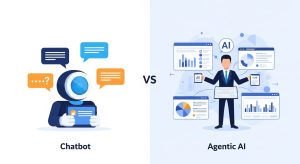
This is the core difference in agentic AI vs chatbots—one assists, the other acts.
Why Agentic AI vs Chatbots Matters Right Now in the U.S.
This shift is not just technical—it’s practical and already happening across industries.
1. Businesses Are Automating Faster Than Ever
Companies in the United States are moving beyond simple chatbots to systems that can:
- Handle workflows end-to-end
- Reduce manual work
- Increase efficiency
2. Productivity Is Becoming AI-Driven
Agentic AI allows teams to:
- Focus on strategy instead of repetitive tasks
- Complete projects faster
- Reduce operational costs
3. Everyday Life Is Changing
Soon, instead of asking AI step-by-step, users will simply:
- Give a goal
- Let AI handle everything
This can impact how people manage finances, shopping, travel, and even personal tasks.
Agentic AI vs Chatbots: Key Differences
| Feature | Chatbots | Agentic AI |
|---|---|---|
| Core Function | Answer questions | Complete tasks |
| Interaction Style | Conversational | Goal-driven |
| Decision-Making | Limited | Advanced |
| Independence | Requires user input | Works with minimal input |
| Use Cases | Support, Q&A | Automation, workflows |
| Efficiency | Moderate | High |
| Real-World Role | Assistant | Digital worker |
This comparison clearly shows why agentic AI vs chatbots is such a trending topic.
Risks and Concerns You Should Know
While agentic AI is powerful, it comes with challenges.
1. Reduced Human Control
When AI starts making decisions, it raises questions about:
- Accountability
- Reliability
2. Job Impact
Automation could:
- Replace repetitive roles
- Shift demand toward skilled professionals
3. Privacy and Security Risks
Agentic AI often connects with multiple systems, which may:
- Increase data exposure
- Create security risks
4. Overdependence on AI
There is a risk that people may:
- Rely too much on AI decisions
- Stop verifying outputs
A balanced approach is important.
What You Should Do Next
If you’re new to AI, here’s how to stay ahead.
1. Start with Chatbots
Learn how AI works by using:
- ChatGPT-style tools
- Customer support bots
2. Explore Agentic AI Tools
As they become available, try:
- Automation platforms
- AI workflow tools
3. Build Future-Proof Skills
Focus on skills that AI cannot easily replace:
- Critical thinking
- Creativity
- Problem-solving
4. Use AI as a Tool, Not a Replacement
The best approach is to:
- Combine human intelligence with AI
- Use AI to boost productivity
Understanding agentic AI vs chatbots will give you a strong advantage.
Future Outlook: What Happens Next?
The future of AI is clearly moving toward autonomy.
Short-Term (1–2 Years)
- More agent-based AI tools
- Integration into apps and workplaces
Mid-Term (3–5 Years)
- Fully automated digital assistants
- AI handling complex workflows
Long-Term
- AI systems collaborating with humans
- Entire processes managed by intelligent agents
Chatbots will still exist, but agentic AI will take the lead.
FAQ: Agentic AI vs Chatbots
1. Is agentic AI replacing chatbots?
Not completely. Chatbots will still be used for simple interactions, but agentic AI will handle complex tasks.
2. Can agentic AI work independently?
Yes, it can plan and execute tasks with minimal human input, though supervision is still important.
3. Is agentic AI available today?
Some early versions exist, but widespread use is still growing.
4. Which is better: agentic AI or chatbots?
It depends on your needs. Chatbots are good for communication, while agentic AI is better for execution.
5. Is agentic AI safe?
It can be safe if used properly, but users should be aware of privacy and decision-making risks.
Conclusion
The debate around agentic AI vs chatbots reflects a major shift in technology. We are moving from systems that simply respond to systems that can act, decide, and complete tasks on their own.
For individuals and businesses in the United States, this change brings both opportunity and responsibility. Those who understand and adapt early will be better prepared for the future.
As experts at RankAshva point out, the real power of AI is no longer just in conversation—it lies in its ability to take action and deliver results.




More Stories
Why the U.S. Government Ordered Restrictions on Anthropic’s Claude Fable 5 and Mythos 5
PURSUE UFO Files: The Truth Behind the May 2026 Declassified Videos
Inside the Oval Office: How Silicon Valley Leaders Stopped the 2026 AI Executive Order