
Quick Answer: Canvas Cyberattack 2026
- The Canvas cyberattack 2026 involves Instructure, the company behind the Canvas learning management system used by many schools and universities.
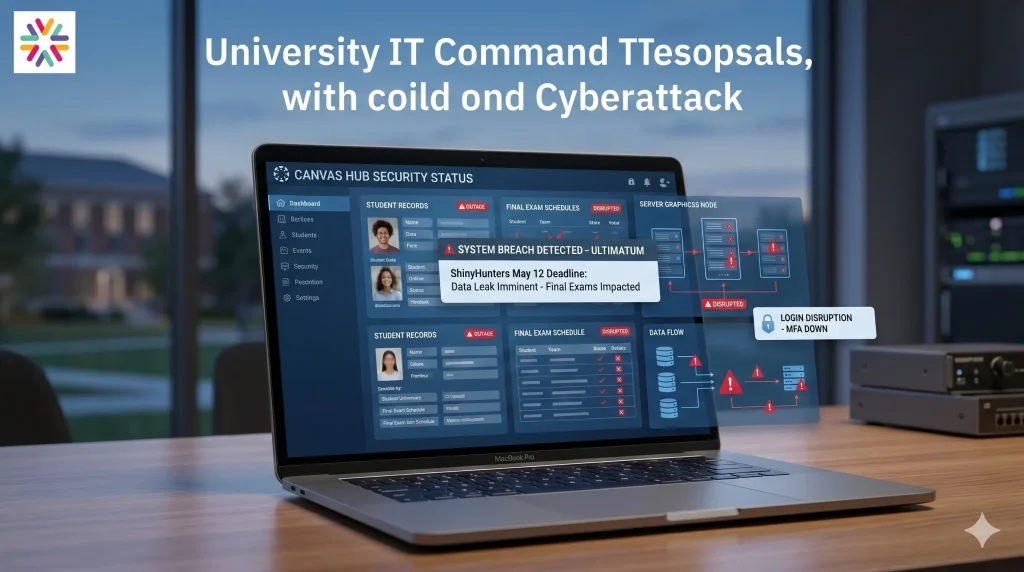
- The hacking group ShinyHunters has claimed responsibility and reportedly set a May 12 deadline tied to a data leak threat.
- Exposed data may include names, email addresses, student ID numbers, course information, and Canvas messages, but current public updates have not shown evidence that passwords, government IDs, birth dates, or financial data were involved.
- The Canvas outage May 2026 disrupted access for some institutions during finals, forcing students and instructors to use backup communication and submission plans.
- Students should avoid suspicious Canvas-related links, monitor official school updates, and save copies of important coursework whenever access is available.
Canvas Cyberattack 2026: What Is Happening?
The Canvas cyberattack 2026 centers on Instructure, the education technology company that operates Canvas, one of the most widely used learning management systems in the United States. Canvas is where many students check assignments, download lecture slides, submit papers, review grades, message instructors, and manage online course activity.
That is why this incident matters so much. Canvas is not just a website. For many universities, it is the digital classroom.
In early May 2026, Instructure confirmed that it was investigating a cybersecurity incident involving a criminal threat actor. Soon after, cybersecurity reports connected the incident to ShinyHunters, a known cybercrime and extortion group. The group claimed it obtained large amounts of Canvas-related user data and later displayed messages on some Canvas login portals as part of an extortion campaign.
The ShinyHunters Canvas hack became even more urgent when the group reportedly set a May 12 deadline, warning that stolen student and institutional data could be leaked if its demands were not addressed.
At the same time, many students began asking a simple question: “Is Canvas down right now?” In some places, the answer changed by the hour. Canvas access was interrupted or restricted at multiple institutions, while Instructure placed systems into maintenance mode and universities posted emergency updates.
Key Details Behind the ShinyHunters Canvas Hack
The available public information suggests that the incident involves user-identifying data from affected institutions. That may include names, email addresses, student ID numbers, course enrollments, and messages exchanged through Canvas.
That kind of data may not sound as dangerous as Social Security numbers or bank details, but it can still create real risks. A student’s name, school email, course information, ID number, and message history can be used for phishing, impersonation, social engineering, targeted scams, or attempts to trick students into sharing passwords.
Instructure and university IT offices have emphasized that, based on currently shared information, there is no public evidence that Canvas passwords, dates of birth, government identifiers, or financial information were involved. Still, the investigation remains important because the final scope of a breach can change as forensic reviews continue.
The University of Pennsylvania Canvas hack reports brought additional attention to the story because Penn was among the institutions specifically discussed in connection with exposed user data. Other universities also posted alerts, status updates, or warnings as the incident unfolded.
Why the Canvas Outage May 2026 Is Trending
The Canvas outage May 2026 is trending because it happened at one of the worst possible times: final exams.
For students, finals week depends on access to course pages, submission portals, study guides, grades, instructor messages, rubrics, and exam instructions. When Canvas goes down or becomes unreliable, the disruption is immediate. Students may not know where to submit an assignment, whether an online quiz is still active, how to access readings, or whether deadlines have changed.
For instructors, the problem is just as serious. Professors and teaching assistants may need to download gradebooks, communicate through email, extend deadlines, move exams, or create backup systems for assignment collection.
This is why the question “How this hack is affecting final exam schedules” has become so important. Some institutions reported temporary outages, emergency guidance, delayed access, alternative submission methods, or exam adjustments. Even where finals were not officially postponed, the uncertainty created stress for students and faculty.
Why It Matters Right Now for U.S. Students and Schools
The United States education system depends heavily on learning management systems. Canvas, Blackboard, Moodle, Google Classroom, and similar tools are not optional extras anymore. They are core infrastructure.
When a platform like Canvas is disrupted, the impact reaches beyond cybersecurity teams. It affects academic deadlines, grading, accessibility accommodations, remote learning, faculty communication, student privacy, and institutional trust.
For students, the biggest immediate concern is access. They need to know whether they can submit assignments, take exams, contact instructors, and retrieve materials.
For universities, the biggest concern is continuity. They must protect data while keeping teaching and learning moving. That balance is difficult during a live security event because allowing access too quickly can increase risk, while restricting access for too long can disrupt academics.
For families, the concern is privacy. Student data leaks can follow people for years, especially if exposed information is combined with data from other breaches.
For businesses and education technology providers, this incident is a warning. LMS cybersecurity 2026 is no longer a technical side issue. It is now part of academic resilience, vendor management, student safety, and public trust.
The Canvas incident shows that education technology is now critical infrastructure. When the classroom moves online, cybersecurity becomes part of academic fairness, student safety, and institutional credibility.
Comparison Table: What Students, Universities, and Instructure Must Manage
| Group | Main Concern | Immediate Risk | Best Next Step |
|---|---|---|---|
| Students | Access to assignments, exams, grades, and messages | Missing deadlines, clicking fake links, or losing access to materials | Follow official school updates, save coursework, and avoid suspicious Canvas prompts |
| Instructors | Teaching continuity and grading | Unable to collect work, review submissions, or communicate through Canvas | Use backup email, download gradebooks if available, and provide flexible instructions |
| Universities | Student privacy, academic continuity, and crisis communication | Confusion, phishing attacks, finals disruption, and reputational damage | Post clear updates, coordinate with Instructure, and support alternate exam plans |
| Instructure | Platform security and customer trust | Data exposure, service disruption, and pressure from extortion claims | Complete forensic review, patch systems, communicate clearly, and support institutions |
| Parents and Families | Student data safety | Scams, impersonation, and anxiety during finals | Encourage students to verify messages before clicking links or sharing information |
Risks, Concerns, and Opposing Views
The main risk is not only that data was accessed. The larger risk is how that data may be used later.
Cybercriminals often use partial personal information to create believable scams. For example, a student may receive a fake email that appears to come from a professor, IT department, financial aid office, or Canvas support team. If the message includes a real course name or university email format, it may look legitimate.
That is why phishing risk is one of the most serious concerns after the ShinyHunters Instructure ransom claims. Even if passwords were not part of the exposed data, attackers may try to steal passwords later through fake login pages.
Another concern is communication. During fast-moving cyber incidents, students may see screenshots, social media rumors, unofficial outage trackers, and conflicting updates. Some of that information may be accurate. Some may be incomplete or misleading.
There is also a fairness issue. Students with limited internet access, disabilities, time-sensitive accommodations, work schedules, or high-stakes final exams may be affected more deeply by LMS disruption. A short outage can feel minor from a technical perspective but major from an academic perspective.
At the same time, universities and vendors face a difficult reality. Taking a system offline can be disruptive, but it may be necessary to protect users while security teams investigate. Not every outage is negligence. Sometimes it is a containment step.
What Students Should Do Now
If you use Canvas, the most important step is to rely on official updates from your school, not random posts or screenshots.
- Check your university’s IT status page. Look for official guidance about Canvas availability, finals, assignments, and emergency procedures.
- Do not click suspicious Canvas links. Be especially careful with emails or messages asking you to reset your password, re-login, open a document, or visit a third-party site.
- Use official login routes only. Access Canvas through your university’s normal website or trusted bookmark.
- Save local copies of important files. Download syllabi, study guides, assignment instructions, and submitted work whenever Canvas is available.
- Ask instructors for backup instructions. If an exam or deadline is close, email your instructor politely and ask what to do if Canvas becomes unavailable.
- Monitor your school email. Universities are likely to use email for emergency academic updates if Canvas messaging is unreliable.
- Be patient but document problems. If you miss a deadline because Canvas was unavailable, take screenshots of outage notices or official updates when possible.
What Universities Should Do During an LMS Cybersecurity Event
Universities should treat LMS outages as academic continuity events, not only IT incidents.
Students need clear, plain-language instructions. Faculty need guidance on deadlines, gradebooks, exam changes, and communication channels. IT teams need to provide updates without overpromising before the investigation is complete.
A strong university response should include a central update page, regular status messages, phishing warnings, faculty guidance, student support instructions, and flexible academic policies where needed.
Schools should also prepare for the possibility that the student data leak ShinyHunters threat could trigger follow-up scams. The days after a breach are often when phishing attempts increase because users are nervous and more likely to click urgent messages.
Is Canvas Down Right Now?
If you are asking “Is Canvas down right now,” the best answer depends on your institution. Canvas may be available for some users while still restricted, slow, or under maintenance for others.
Use these steps:
- Visit your school’s official IT status page.
- Check Instructure’s public status page for broad platform updates.
- Look for messages from your instructor, department, registrar, or campus technology office.
- Avoid unofficial links claiming to restore access or bypass the outage.
If Canvas is unavailable and you have an urgent final, email your instructor or department using your official school email account. Keep the message short, include the course name, explain the access issue, and ask for the approved backup submission or exam plan.
Future Outlook: What Happens After the May 12 Deadline?
The ShinyHunters May 12 deadline is important because it creates a public pressure point. If the group follows through on its threat, more data could be posted or shared. If negotiations, containment, or legal action change the situation, the outcome could be different.
Students should not assume the story ends immediately after the deadline. Cybersecurity incidents often continue for weeks or months as institutions investigate, notify affected users, restore systems, and monitor for scams.
Universities may also review their vendor contracts, incident response plans, data retention policies, and backup systems. One likely result is stronger pressure on education technology companies to prove that they can protect student information and keep platforms reliable during emergencies.
For the broader education sector, this incident could accelerate a shift toward better LMS cybersecurity, more regular vendor audits, stronger authentication, improved data minimization, and clearer emergency plans for digital classrooms.
FAQ: Canvas Cyberattack 2026
What is the Canvas cyberattack 2026?
The Canvas cyberattack 2026 is a cybersecurity incident involving Instructure, the company behind the Canvas learning management system. The hacking group ShinyHunters has claimed responsibility, and affected data may include user-identifying information and Canvas messages.
What is the ShinyHunters May 12 deadline?
The ShinyHunters May 12 deadline refers to the group’s reported threat to leak stolen data if its demands are not addressed by that date. Students and universities should watch official updates rather than relying on social media rumors.
Did the Instructure data breach expose Canvas passwords?
Current public updates have not shown evidence that Canvas passwords, dates of birth, government IDs, or financial information were involved. However, users should still watch for phishing attempts and avoid suspicious login links.
How is this hack affecting final exam schedules?
The hack and related Canvas outage have disrupted access to course materials, assignments, messages, and grade tools at some institutions during finals. Some schools and instructors may extend deadlines, adjust exams, or provide alternate submission methods.
What should I do if Canvas is down before an exam?
Check your school’s official IT status page, monitor your school email, and contact your instructor using your official university account. Save proof of the outage and ask for the approved backup plan for submissions or exams.
Conclusion
The Canvas cyberattack 2026 is more than a technology problem. It is a reminder that modern education depends on digital systems that must be secure, reliable, and prepared for crisis moments.
For students, the immediate priorities are simple: follow official updates, avoid suspicious links, save key coursework, and communicate early if finals or assignments are affected. For universities, the priority is clear communication, flexible academic planning, and stronger long-term vendor oversight.
In RankAshva editorial view, the real lesson is simple: a learning platform is no longer just software. It is part of the classroom itself, and protecting it is now part of protecting education.




More Stories
Why the U.S. Government Ordered Restrictions on Anthropic’s Claude Fable 5 and Mythos 5
PURSUE UFO Files: The Truth Behind the May 2026 Declassified Videos
Inside the Oval Office: How Silicon Valley Leaders Stopped the 2026 AI Executive Order