
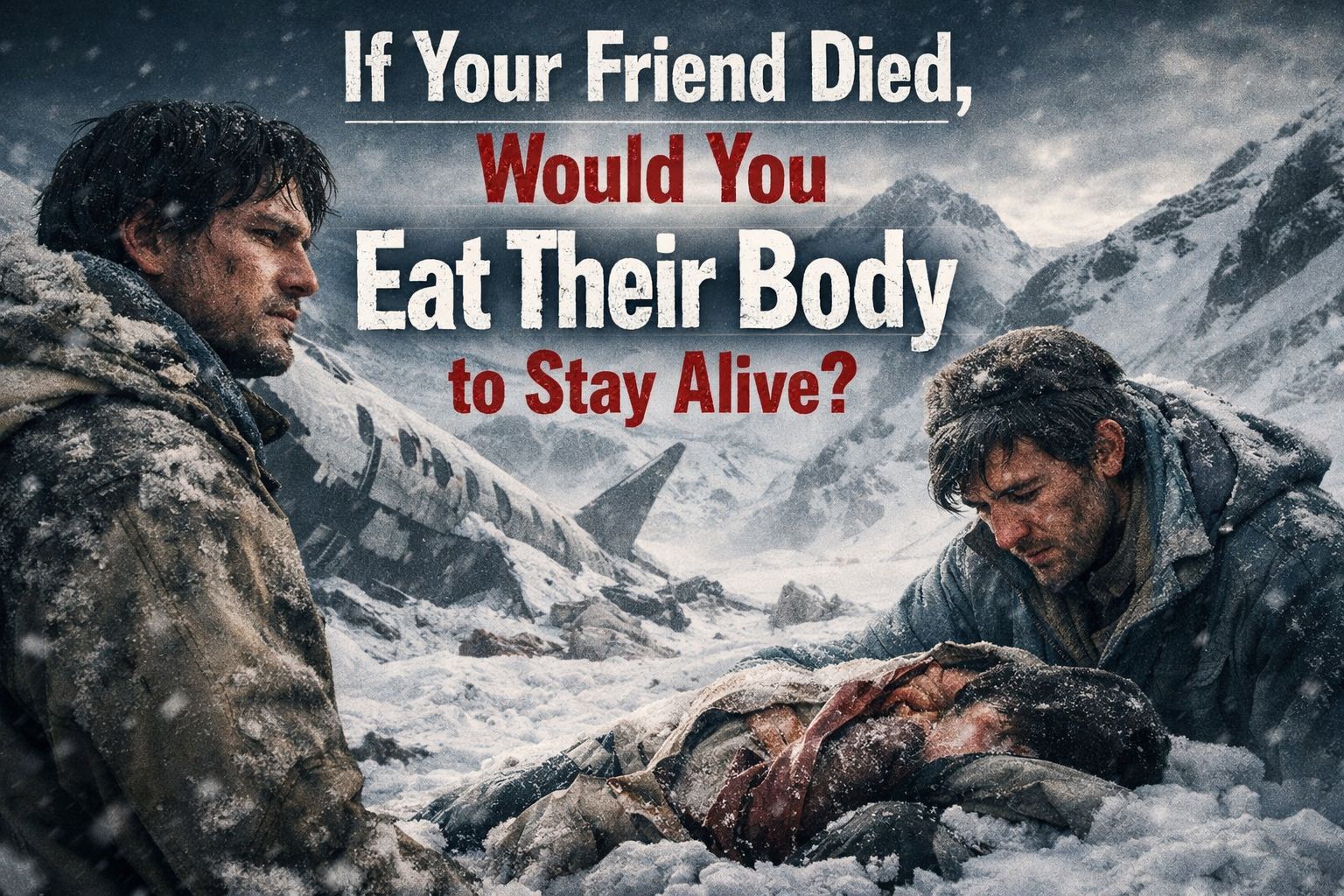
Most people answer this question quickly—because they answer it from comfort. A full stomach. A warm room. The quiet assumption that
help always comes eventually. From there, morality feels solid and permanent. Certain lines feel impossible to cross.
But morality doesn’t live in a vacuum. It lives inside conditions. Change the conditions—remove food, remove warmth, remove certainty,
remove rescue—and the human mind begins to change with them. Not because people become evil, but because the brain is built to protect life
first and explain it later.
After two months in the Andes in 1972, a group of young rugby players and other passengers were forced to discover something most of us only
debate abstractly: what you believe you’d do and what you actually do can become two different things when death is close enough to touch.
The Real Story, From Beginning to End
The Departure and the Delay
In October 1972, a chartered military aircraft—carrying members of a Uruguayan rugby team (Old Christians Club), along with friends,
family, and crew—set out for Chile. The route required crossing the Andes, a mountain range famous for harsh weather and dangerous flying
conditions.
The trip was not a clean, simple one-day journey. Weather and logistics led to delays, and the flight that attempted to cross the
mountains would do so under pressure, with limited navigation tools compared to what we expect today.
What matters for this blog isn’t only the aviation detail—it’s the psychological one:
- At the start, everyone was still living inside “normal reality.”
- In normal reality, morality is easy.
- You can afford principles because you can afford food.
Then normal reality ended.
The Crash: One Moment, One Mistake, and a New World
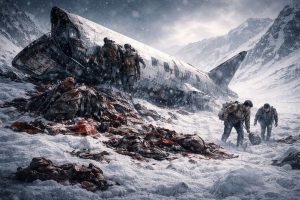
believed they had cleared the mountains and began descending—but they were still surrounded by peaks.The aircraft struck a mountain. Parts of the plane tore away. The remaining fuselage slid down snow and rock, eventually coming to rest in
a frozen, high-altitude wilderness.There were 45 people onboard. Many died in the crash or shortly after. Others survived with severe injuries, shock, and
immediate exposure to brutal cold.
The survivors had no “base camp.” No shelter beyond wreckage. No food supply. No medical kit built for weeks of trauma. And no clear idea
where they were.
In the earliest hours, you don’t see “philosophy.” You see triage.
- Who is alive?
- Who is bleeding?
- Who can move?
- Who needs help now?
This is the first shift in morality: it becomes practical. Not cold. Not cruel. Practical.
In crisis, morality doesn’t vanish—it narrows. The mind focuses on the next breath, the next hour, the next night.
The First Days: Hope Keeps Morality “Normal”
Why Hope Matters So Much
During the first days, survivors often behave the way you’d expect “good people” to behave:
- They share limited resources.
- They comfort the injured.
- They cooperate.
- They expect rescue.
Hope is not just emotional—it’s a structure. As long as rescue seems likely, the brain keeps many social rules intact.
This is important:
When we imagine extreme choices, we forget how long people try to remain “normal” before they change.
The Cold Becomes a Character in the Story
The Andes are not only cold. They are deceptively deadly.
Cold does this to the mind:
- It drains energy.
- It reduces optimism.
- It creates fatigue that feels like surrender.
- It makes every decision heavier.
At night, survival becomes simple and brutal: do not freeze.
They used what they had—wreckage, clothing, bodies close together—to preserve heat. And as days passed, the survivors learned that the
environment wasn’t simply uncomfortable. It was actively trying to kill them.
When the Search Ends: The Psychological Earthquake
“No One Is Coming” Changes Everything
Early on, rescue planes searched. But the wreckage blended into snow and ice. Visibility, weather, and terrain made it difficult to locate
them. After days of no success, the official search was eventually called off.
When survivors realized the search had stopped, it shattered the mental foundation holding them together.
Because the moral world most of us live in assumes:
- Help exists.
- Time exists.
- If you wait long enough, the system finds you.
When that assumption dies, a new kind of thinking begins.
When rescue disappears, time becomes a predator.
Starvation: How the Mind Rewrites the Rules
Hunger Is Not a Debate—It’s a Force
Prolonged hunger changes cognition. People don’t just “feel hungry.” They become:
- more impulsive,
- more emotionally raw,
- more tunnel-visioned,
- more focused on immediate survival.
At this stage, morality stops being “What is right?” and starts becoming “What is possible?”
This is the moral pivot point in the story.
Their options narrowed:
- No vegetation.
- No animals to hunt.
- No stored food.
- No rescue.
Soon, the survivors faced the question your title asks. Not as philosophy. As reality.
The Unthinkable Decision
Eventually, some survivors decided to use the only available source of nourishment: the bodies of those who had already died.
It wasn’t casual. It wasn’t impulsive in the way people imagine. It was tragic logic:
- doing nothing meant death,
- this choice meant life,
- life would come with psychological consequences.
This is where the blog’s true theme lives: Morality didn’t disappear. It changed shape.
They were not choosing “evil.” They were choosing between life and death—and paying a moral price for life.
A comfortable person asks, “How could they?”
A starving person asks, “How long until I can’t think at all?”
The Avalanche: When Nature Erases Progress
A Second Disaster Inside the First
As if hunger and cold weren’t enough, an avalanche struck the wreckage, burying the survivors and killing more people. It also trapped them
in a tighter, darker, more suffocating reality—where even movement could mean death.
This kind of event changes morality again, in a subtler way:
- You stop believing the world is fair.
- You stop believing endurance guarantees reward.
- You stop making decisions based on what “should” happen.
- You start making decisions based on what does happen.
Survival becomes less about hope and more about discipline.
The Turning Point: Two Survivors Choose Movement Over Waiting
Why Waiting Became Death
By early December, waiting had become a slow form of surrender. They needed action. Not because action was safe—but because inaction was
fatal.
Two survivors—Nando Parrado and Roberto Canessa—made the decision to attempt the impossible: to walk across
the Andes to find help.
They were not equipped like mountaineers. They were not well-fed. They were not certain which way to go. But the logic had become clear:
- Stay and die, or
- Walk and possibly live.
This is one of the most powerful moral moments in the story, because it shows something easily missed:
The same survival instinct that pushes people to compromise can also push people to sacrifice.
Parrado and Canessa weren’t walking only for themselves. They were walking for everyone still alive at the crash site.
The Trek: How Far the Human Body Can Go When the Mind Refuses to Stop
Ten Days That Redefined “Limit”
Parrado and Canessa walked for roughly 10 days, enduring altitude, snow, exhaustion, and uncertainty. They were chasing a
hope that had already been proven fragile.
Eventually, they encountered signs of life—then a person. They made contact with a Chilean muleteer (a local horseman) and communicated
their situation. That moment was the hinge between death and rescue.
Soon, authorities were alerted. Rescue teams mobilized.
The Last Days: Discovery, Rescue, and What Survival Leaves Behind
Rescue Arrives
On December 22, 1972, survivors were rescued—after approximately 72 days stranded in the Andes.
Not everyone could be evacuated at once due to conditions. But the rescue happened. The world returned.
Yet the survivors didn’t return to the world as the same people who boarded the plane.
The “After” Is Part of the Story
The last day isn’t only helicopters and relief. It’s also the first day of a new psychological reality:
- media attention,
- public judgment,
- private grief,
- lifelong memory.
A survival choice can save a body and still wound a mind.
That doesn’t mean survival was wrong. It means survival is not clean.
Timeline Table: What Happened, and How the Mind Shifted
| Phase | What Happened | What It Did to Morality |
|---|---|---|
| Departure | Normal travel expectations | Morality feels absolute |
| Crash | Sudden disaster, injuries, deaths | Morality narrows into triage |
| Early days | Hope of rescue | Social rules stay strong |
| Search ends | Realization rescue may not come | Morality becomes situational |
| Starvation | No food, weakening bodies | Survival overrides taboo |
| Avalanche | More deaths, entrapment | “Should” becomes irrelevant |
| Trek begins | Parrado + Canessa leave | Action becomes moral duty |
| Rescue | Survivors found and evacuated | Morality shifts into reflection |
What This Story Teaches About Human Morality
1) Morality is easier when the stakes are low
Most moral certainty is built on security. When security vanishes, morality is forced to negotiate with biology.
2) The brain protects life before identity
A starving mind is not the same mind. Values still exist, but survival becomes the organizing principle.
3) Judgment is often a luxury
People judge from comfort because comfort hides the full weight of desperation.
4) Survival choices don’t erase guilt
Many survivors of extreme events report complicated feelings—because the mind can be both grateful and haunted.
Key Takeaways
- Morality doesn’t vanish in crisis—it changes shape.
- Hope keeps people “civilized” longer than outsiders expect.
- Starvation and cold push the brain into survival mode.
- Inaction becomes its own decision when rescue disappears.
- Parrado and Canessa’s trek shows that survival instinct can produce sacrifice, not only compromise.
- The end of the story isn’t rescue—it’s living with what survival required.
FAQ
Why ask such an uncomfortable question?
This question isn’t meant to shock or provoke for attention. It exists to explore how human morality changes under extreme conditions—when hunger, fear, and the certainty of death replace comfort and choice. Situations like the Andes plane crash force us to confront the gap between who we believe we are and who we might become when survival is at stake. By asking the question directly, we strip away abstraction and examine human nature honestly, without judgment.
How many people were on the plane, and how many survived?
There were 45 onboard, and 16 ultimately survived.
Why didn’t rescuers find them sooner?
The wreckage blended into snow and terrain. Weather, visibility, and the vast search area made detection extremely difficult.
Is it fair to judge survival cannibalism?
It’s complicated. A fair moral evaluation requires understanding the conditions: starvation, isolation, certainty of death without action.
Judgment without context is often incomplete.
What does this story reveal about “human nature”?
It shows that human nature is adaptive. Under extreme threat, the mind reorganizes priorities—sometimes in ways that feel unrecognizable
from ordinary life.
Conclusion
If your friend died, would you eat their body to stay alive?
The uncomfortable truth is that most people do not know—because most people have never lived in the conditions where the question stops
being a thought experiment and becomes a countdown.
This story is not famous because it is shocking. It is famous because it forces a mirror in front of us:
- How quickly do our rules change when survival is on the line?
- How much of morality depends on safety?
- And what does it mean to be human when being human costs too much?
Morality is not tested in comfort.
It is tested when the alternative is extinction.




More Stories
100 Non-Negotiable Rules for Men
Salvaging Wardrobes: The Definitive Guide to Removing Set-In Grease Stains After Washing
Restoring Clarity: How to Clean Oven Glass With Baking Soda Without Harsh Chemical Sprays